As a counselor to new mothers and caregivers, Christina M. Schultz, MA has seen many women experience, “caregiver burnout” or complete fatigue, exhaustion, depression, resentment, loss of identity, and sense of low self-worth. To help those who may be at risk of burnout, Schultz has created this Self Care Plan for Moms & Caregivers.
I often hear women who devalue their self-worth and chose to take care of others as their first and foremost priority. I work to encourage women who are mothers and caregivers to place self-care as their top priority to prevent burnout, to provide resilience and empowerment, and because it helps women to maintain appropriate boundaries in the spousal, parenting, and/or caregiving relationships and roles.
For any women attempting to balance role demands of parenting, work, caregiving, marriage, and relationships with family-of-origin, self-care and boundaries are your key to balanced living. A whole self-care plan needs to integrate the four aspects of you – which includes physical, emotional, social, and spiritual health. Below are a few key suggestions for any self-care plan.
Self Care Plan for Moms & Caregivers
Build a Support System or Network Outside of Your Spouse, Children, and Parents (Social and Emotional Needs). This is important in order for you to not over rely on the emotional and social needs from your immediate family, and help you to not be over-preoccupied on the needs of your family. I encourage you to find or create your own peer support group of moms, caregivers, and so forth.
Ask for and Accept Help. Clarify and Strengthen Relationship and Responsibility Boundaries and Division of Labor of the Household, Parenting, and Financial Admin Duties (Emotional and Physical Needs). This is important for you to reduce your role demands and overload if you have the tendency to do too much. This is also your chance to assertively communicate your needs and desires with your spouse and negotiate a win-win for you both. Your spouse should want to find a middleground, and if not, you need to consider how you may be selling your needs short. If you lack the time and have the financial resources, you and your spouse have the option to hire more help with cleaning, childcare, and financial planning and investing duties.
Assertive Communication of Needs. Learn how to assertively and appropriately ask for help and the love you need with “I” statements (Social and Emotional Needs). If you ask for help clearly, assertively, and appropriately, you will be received with respect and people will tend to meet your needs. It is suggested to encourage children as young as toddler-age to help with chores, and to increase their responsibility over time. It is also suggested to communicate your needs for emotional and sexual intimacy from your spouse, and specific help you need from your spouse since your partner is not a mind-reader. “I” language assertively communicates your feelings with a specific need. As one example: “I feel upset that I make dinner every night each week. I would appreciate it if you cooked Mondays and Fridays or if we ordered take out those nights. What do you think about this?”
Make time for yourself to exercise, sleep, and eat several balanced meals each day, and attend your annual health appointments (Physical Needs).
Learn how to say no and prioritize (Emotional and Physical Needs). If you are someone who tends to err on “doing too much” than you have to learn how to say no and dig further on what you may be avoiding with your business. Sometimes business has a secondary gain, such as the avoidance of people rejecting our requests for help and/or avoidance of feeling lonely.
Pray, meditate, and/or read something grounding once a day for a few minutes (Spiritual Needs). Research has established that people who engage in positive religious and spiritual coping, whether tied to an organized religion or not, tend to be mentally healthier and approach distressing life events with increased resilience. Whether you find calm and strength from attending Church weekly, praying each day, engaging in mindfulness meditation, or reading a powerful deep quote each day, it is an important way to keep yourself in-touch with your deeper values and meaning, beyond the trivialities of life.
Write down or verbalize three things you are grateful for each day to build more appreciation in your life. (Emotional and Spiritual Needs). This positive psychology exercise is linked to increased feelings of meaning and satisfaction in the here-and-now, and reduced depression.
Considering extra support when your newborn or twins arrive? Before the interview, it might be helpful to think about what aspects of baby care will be most helpful to you. This guide, Questions to Ask When Hiring a Night Nanny or Postpartum Doula is a starting point for families considering night doula care of their newborns, infants or twins.
Joy, LPN has lots of experience with twins and multiples!
Key Things to Consider Before Hiring Newborn Help
Daytime vs. Overnight Care Do you need someone who helps during the day with light household tasks and older siblings, or is overnight sleep your top priority? Read What’s a Night Nanny? Roles, Benefits, Costs and How They Help Families if you’d like to learn exactly what happens when you hire a night doula.
Support for Your Feeding Choices Do you want help with breastfeeding, pumping, or bottle feeding? Look for someone trained and nonjudgmental.
Experience and Certifications Is it important to you that your caregiver has formal training, years of hands-on experience, or both?
Sleep Philosophy Do you want someone to support sleep training, baby-led schedules, or a flexible approach?
Vaccination Status – In healthcare roles, you can ask a caregiver their vaccination status in order to protect your newborn who is too young to be vaccinated themselves.
Questions to Ask When Hiring a Night Nanny or Postpartum Doula
1. Would daytime or overnight care be more helpful for my family?
A daytime nanny can help with older children and household tasks, while an overnight nanny allows parents to maximize rest. Consider your family’s needs, work schedules, and recovery time.
Real life scenario:if you have a short maternity leave and need to return to work quickly, having uninterrupted overnight sleep may be most valuable for recovery. If you have older children, a daytime nanny might give you the space for one-on-one bonding time with each child while ensuring the newborn’s needs are met
2. Do I want support with breastfeeding, pumping or bottle feeding?
Postpartum doulas can offer lactation guidance, help with pumping routines and ensure bottle feeding is safe and consistent. Feeding choices often evolve, so it’s best to work with someone flexible and nonjudgemental.
Real life scenario:A mom recovering from a C-section desperately wants to breastfeed but is in pain and exhausted. Her night doula suggests 1 formula feed overnight, giving the mother a long stretch of uninterrupted sleep and a chance to recover. The next day they assessed and followed the same plan again. Over time the mother recovered without feeling pressured or like she was “failing.”
3. What kind of newborn and postpartum care experience do the doulas have?
Newborn and infant care (0-12 months) requires specialized knowledge: safe sleep, swaddling, soothing techniques and recognizing infant feeding and sleep cues. An academic training program that uses evidence-based practice can ensrue hte caregiver is up to date on safety recommendation. Also ask about hands-on experience, especially with twins or multiples. Remember: only licensed nurses (RN, LPN, LVN, CNM) can legally use the title “nurse” or “baby nurse.” If you’d like to learn more about safe sleep before baby arrives, read 10 Steps to Safe Sleep for Baby.
Real life scenario: There are many parents of twins who go on to work overnight helping other parents with newborn twins. While this caregiver may not have had formal training, their life experience might be the perfect fit for a family expecting twins.
4. How should my newborn caregiver approach infant sleep? Do I want someone to help my baby sleep through the night, or will I be more of a ‘go with the flow’ type?
Some families aim for babies to sleep through the night quickly, while others prefer a baby-led, flexible routine. There’s no right or wrong answer, but your caregiver should align with your philosophy, whether that’s sleep training, attachment parenting or getting baby on a schedule
Real life scenario:Sleeping through the night is often seen as the “finish line” in infant care, especially when newborn twins arrive because caring for 2 newborns is so physically demanding. A night doula who understands and supplements your sleep philosophy means consistency of care. It will be helpful to think about how you feel about sleep training, attachment parenting or getting baby on a schedule before baby arrives.
Questions to Ask a Night Nanny for Your Newborn Twins
Families expecting twins often consider hiring help, especially if they have older children as well. Think about what benefits your family the most- overnight sleep help or daytime support with feedings, laundry and older kids. You might want overnight newborn care while you recover and then a transition to daytime nanny care.
Feeding Support: Ask: Can your nanny support you with tandem breastfeeding, bottle-feeding or pumping schedules? Choose someone flexible and experienced with twin feeding routines.
Experience with Twins: Ask: How many sets of twins or triplets has the caregiver supported? Ask about specific training in safe sleep, soothing and tracking feeds for multiples. Remember, even if they haven’t specifically cared for twins, they may have cared for babies close in age and this can be helpful experience too.
Sleep Philosophy: Does the night doula promote baby-led or scheduled sleep? Does this align with your approach? Twins often thrive on coordinated routines, so confirm that your philosophies work together.
Safety & Vaccination: Since newborns are too young for vaccines, ask if your nanny is current on Tdap, Flu and MMR, and what their hygiene practices are.
Quick Takeaway: The best night nanny for twins blends hands-on experience with flexibility. Look for a caregiver who supports your feeding choices, prioritizes safety and helps both babies (and parents) get the rest they need.
Questions to Ask When Hiring a Night Nanny or Postpartum Doula – Final Thoughts
The titles may vary from postpartum doula, night nanny to newborn care provider, but the goal is the same: reliable, compassionate support during the postpartum phase. Choose someone who respects your parenting choices, communicates clearly and helps your whole family thrive.
updated, Nov 1, 2025 – Parents often hear about the importance of tummy time, yet overwhelmingly report their babies don’t want to do it! Tummy Time Troubles Solved has tips to help baby enjoy tummy time.
Why Does Your Newborn Need Tummy Time?
Newborns and infants often seem uncomfortable with being placed on their bellies when they’re awake, so why do we do it? Babies spend a LOT of time sleeping. And since it’s been proven that placing babies on their backs to sleep for the first year is one of the best ways to minimize the risk of SIDS, they also spend a LOT of time on their backs. Because of this, we need to give newborns and infants opportunities to exercise their next and shoulder muscles. Stronger muscles = healthier and safer babies. In addition to building neck and shoulder strength, tummy time supports motor development, prevents flat spots (positional plagiocephaly), and helps babies learn to push up, roll and eventually crawl. It’s not just exercise, it’s the foundation for all future movement skills.
So yes, tummy time is your baby’s workout and just like us, sometimes they don’t feel like working out! With slight but important adjustments though, infants can have comfortable, yet productive play and exercise.
Infant expert Terri Lee Weatherholtz, M.A, CCC-SLP, CDA says: “the time an infant is awake on the floor should consist of 50% back and 50% tummy time.” There’s no exact rules on when to begin tummy time sessions with your baby. Chances are it’s something you and your baby are doing together naturally anyway!
As a guideline however, you can start with 3-5 minute sessions 2-3 days after baby is born, and this is an accepted rule of thumb. As baby grows, tummy time can gradually increase to about 20–30 minutes a day by the time they’re 3 months old. Short, frequent sessions are better than long ones, think “floor time snacks,” not “floor time marathons.”
RN Noelle explains, Tummy Time Troubles Solved
Tummy Time Troubles Solved – Steps for Success
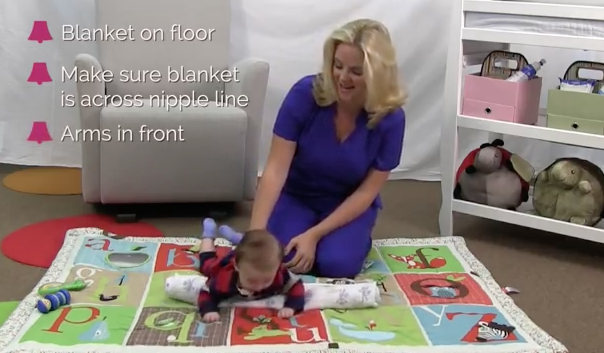
Roll a thin baby blanket (3–4 inches thick) to create a small chest lift.
Place baby tummy-down with arms out front and chest resting at nipple level on the blanket.
Keep the neck clear of the blanket so weight shifts backward off the tummy.
Encourage movement: Use a firm but gentle stroke from the back of the head down to the bottom to activate the neck extensor muscles.
Get face-to-face: Lie down on the floor to make eye contact. Smiling and talking help your baby lift their head and build social connection at the same time.
Try chest-to-chest: Lying on your back with baby on your chest lets them look “up” at your face—a natural tummy time position for even the youngest infants.
Another way to help tummy time be a fun activity is to lay on your back with baby on your chest, so you’re face to face. With a gentle hold on baby for safety of course, baby will be motivated to look “up” at your face.
Night Nurse’s Reminder- Always supervise tummy time and use a flat, firm surface instead of a couch or bed to be sure baby is safely positioned.
It’s perfectly fine if tummy time only lasts 5 minutes or less some days. Eventually continuing the routine a few times a day for longer periods though, helps your baby equate “tummy time” with happy, social time. As always, if your baby consistently dislikes tummy time or shows limited movement or head control after a few weeks, talk to your pediatrician or a pediatric physical therapist.
{
“@context”: “https://schema.org”,
“@graph”: [
{
“@type”: “BreadcrumbList”,
“itemListElement”: [
{
“@type”: “ListItem”,
“position”: 1,
“name”: “Home”,
“item”: “https://www.letmommysleep.com/”
},
{
“@type”: “ListItem”,
“position”: 2,
“name”: “Newborn Care”,
“item”: “https://letmommysleep.com/blog/category/newborn-care/”
},
{
“@type”: “ListItem”,
“position”: 3,
“name”: “Tummy Time Troubles Solved”,
“item”: “https://letmommysleep.com/blog/2017/05/02/tummy-time-troubles-solved”
]
},
{
“@type”: [“Article”, “MedicalWebPage”],
“mainEntityOfPage”: {
“@type”: “WebPage”,
“@id”: “https://letmommysleep.com/blog/2017/05/02/tummy-time-troubles-solved/”
},
“headline”: “Tummy Time Troubles Solved: How to Help Your Baby Enjoy Tummy Time”,
“description”: “Expert tips from postpartum doulas, RNs, and infant specialists on safe and effective tummy time for newborns and infants, including step-by-step guidance and video demonstration.”,
“author”: {
“@type”: “Organization”,
“name”: “Let Mommy Sleep”,
“url”: “https://www.letmommysleep.com”,
“logo”: “https://www.letmommysleep.com/logo.png”,
“sameAs”: [
“https://www.linkedin.com/company/let-mommy-sleep-llc”,
“https://www.pinterest.com/letmommysleep”,
“https://www.facebook.com/letmommysleepnightnurses”
]
},
“publisher”: {
“@type”: “Organization”,
“name”: “Let Mommy Sleep”,
“logo”: {
“@type”: “ImageObject”,
“url”: “https://www.letmommysleep.com/logo.png”
}
},
“datePublished”: “2025-11-01”,
“dateModified”: “2025-11-01”,
“keywords”: “tummy time, newborn exercise, infant development, safe sleep, infant motor skills, early care, newborn care guide”,
“citation”: [
“American Academy of Pediatrics. Safe Sleep Guidelines for Infants. https://www.aap.org/en/patient-care/safe-sleep/”,
“NIH Guidelines for Infant Tummy Time. https://www.nichd.nih.gov/health/topics/infant-care/conditioninfo/tummy-time”
],
“video”: {
“@type”: “VideoObject”,
“name”: “Tummy Time Troubles Solved”,
“description”: “Tips to help babies enjoy tummy time, including proper positioning, interaction techniques, and safety guidance.”,
“thumbnailUrl”: “https://img.youtube.com/vi/jGHjojXPal0/0.jpg”,
“uploadDate”: “2025-11-01”,
“contentUrl”: “https://www.youtube.com/watch?v=jGHjojXPal0&t=9s”,
“embedUrl”: “https://www.youtube.com/embed/jGHjojXPal0”,
“duration”: “PT5M”
},
“hasPart”: [
{
“@type”: “WebPageElement”,
“name”: “Why Does Your Newborn Need Tummy Time?”,
“headline”: “Why Does Your Newborn Need Tummy Time?”,
“text”: “Tummy time builds neck, shoulder, and core strength, supports motor development, prevents flat spots, and helps babies learn to roll, push up, and crawl. It is essential for healthy movement development.”,
“citation”: “Terri Lee Weatherholtz, M.A., CCC-SLP, CDA; Let Mommy Sleep postpartum doulas”
},
{
“@type”: “WebPageElement”,
“name”: “Tummy Time Troubles Solved – Steps for Success”,
“headline”: “Tummy Time Troubles Solved – Steps for Success”,
“text”: “1. Roll a thin baby blanket (3–4 inches thick) to create a chest lift.\n2. Place baby tummy-down with arms out front and chest at nipple level.\n3. Keep the neck clear of the blanket.\n4. Encourage movement by gently stroking from head to bottom.\n5. Lie face-to-face to motivate head lifting.\n6. Chest-to-chest on your body can also make tummy time fun for young infants.\n7. Always supervise and use a firm, flat surface.”,
“citation”: “RN Noelle; Let Mommy Sleep infant care guidance”
},
{
“@type”: “WebPageElement”,
“name”: “Tummy Time Safety Tips”,
“headline”: “Night Nurse’s Reminder – Safety Tips”,
“text”: “Always supervise tummy time. Use a flat, firm surface instead of a couch or bed to ensure the baby is safely positioned. Short sessions are fine; consistency matters more than duration. Seek pediatric advice if baby consistently resists tummy time or shows limited movement.”,
“citation”: “American Academy of Pediatrics; Let Mommy Sleep expert guidance”
}
],
“speakable”: {
“@type”: “SpeakableSpecification”,
“xpath”: [
“/html/body//h1”,
“/html/body//h2[contains(text(),’Why Does Your Newborn Need Tummy Time?’)]”,
“/html/body//h2[contains(text(),’Tummy Time Troubles Solved – Steps for Success’)]”,
“/html/body//h2[contains(text(),’Night Nurse’s Reminder’)]”,
“/html/body//video”
]
}
},
{
“@type”: “FAQPage”,
“mainEntity”: [
{
“@type”: “Question”,
“name”: “When should I start tummy time with my newborn?”,
“acceptedAnswer”: {
“@type”: “Answer”,
“text”: “You can start tummy time with 3–5 minute sessions 2–3 days after birth. Increase gradually as your baby grows, aiming for 20–30 minutes per day by around 3 months.”
}
},
{
“@type”: “Question”,
“name”: “Why is tummy time important for my baby?”,
“acceptedAnswer”: {
“@type”: “Answer”,
“text”: “Tummy time strengthens neck and shoulder muscles, supports motor development, prevents flat spots, and helps babies learn to push up, roll, and crawl.”
}
},
{
“@type”: “Question”,
“name”: “How can I make tummy time more enjoyable for my baby?”,
“acceptedAnswer”: {
“@type”: “Answer”,
“text”: “Use a thin chest lift blanket, get face-to-face for interaction, try chest-to-chest positioning, and keep sessions short but consistent.”
}
},
{
“@type”: “Question”,
“name”: “Is it safe to place my baby on a bed or couch for tummy time?”,
“acceptedAnswer”: {
“@type”: “Answer”,
“text”: “Babies should be on a flat, firm surface for tummy time. Beds and couches are unsafe because babies can roll or become trapped. Only supervised, awake play on a firm bed is acceptable for brief sessions.”
}
},
{
“@type”: “Question”,
“name”: “What should I do if my baby resists tummy time?”,
“acceptedAnswer”: {
“@type”: “Answer”,
“text”: “Short, frequent sessions are normal. If resistance continues or your baby shows limited head or neck movement after a few weeks, consult your pediatrician or a pediatric physical therapist.”
}
}
]
}
]
}
updated December 6, 2025 Designing the nursery is a wonderful way to connect with baby before birth but the most important part of nursery planning is safety. Creating a Safe Nursery for Baby shows you how to make a nursery that is as cute as your newborn but still practical and safe.
Creating a Safe Nursery for Your Baby
Creating a Safe Nursery for Baby
In our Essential Guide: How To Prepare Your Home for a Newborn parents learn all about how to make a safe and organized home set-up when they arrive home with their newborn. Setting up the nursery is something you’ll want to do well before your baby is born because you’ll actually have time to do it and some things, like airing out mattresses and furniture, need to be done before baby uses them. Here’s a breakdown of everything that needs to happen in the nursery:
Toxic Fumes
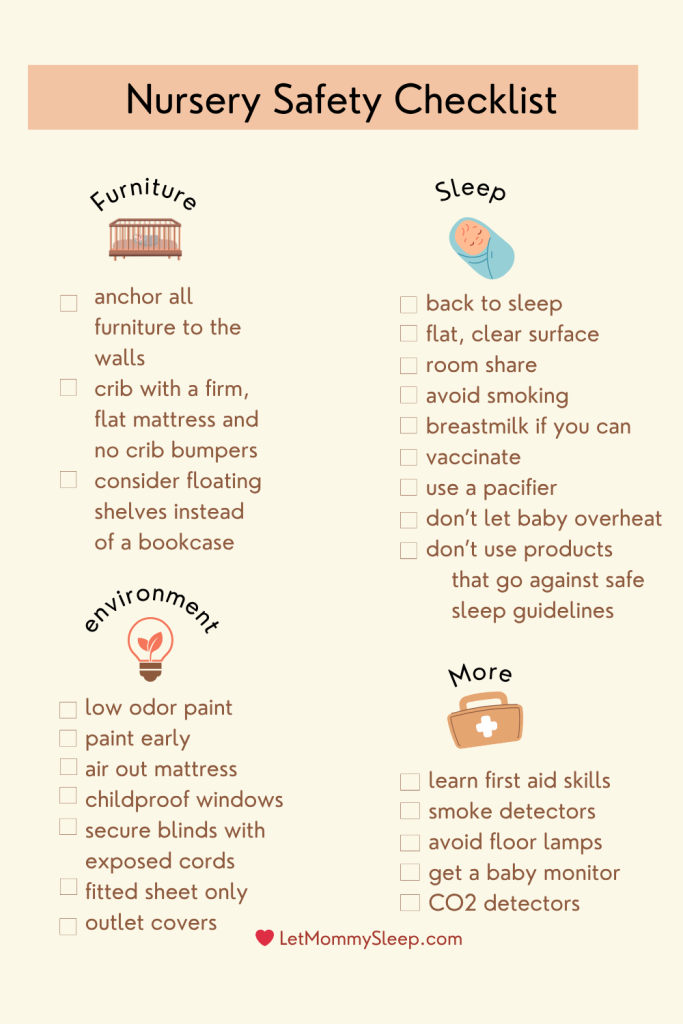
You should paint your nursery with low-odor interior paint, and do so early enough so any odors can fade. The same is a good idea with the nursery furniture. Put it together with plenty of time to spare and be sure that only non-toxic paint has been used.
Air out the new crib mattress until baby needs to sleep there.
Leave all furniture drawers open to air them out until needed.
Consider hardwood flooring vs. carpeting to reduce dust and odors. Purchase an area rug that is sturdy and practical, as it will likely be a play area for tummy time.
Window Safety
Childproof all nursery windows with window stops or window guards.
Hang curtains or other wall dressings with properly secured materials, installing them into wall studs and/or with dry wall anchors. Never use tension rods!
Secure blinds with long, exposed cords to reduce risk of strangulation.
Furniture
Anchor all furniture to the walls to make sure it doesn’t tip over, including the changing table. Materials for this are very inexpensive but potentially life-saving. Be sure to anchor into wall studs.
Night Doula Tip: Consider floating shelves instead of bookcases. Even if it’s anchored, floating shelves become a ladder to toddlers!
Cribs should have only a fitted sheet. No stuffed animals, breathable crib bumpers only and be set up following American Academy of Pediatrics guidelines.
Safe Sleep for Infants Age 0-1 Year Old
Safe sleep recommendations mean baby will sleep in the same room, but not in the same bed, as a parent for 6 months. After 6 months and for the times they take naps in the nursery here are the basics of Safe Sleep. Learn more at 10 Steps to Safe Sleep for Baby
Back to Sleep – Sleeping flat on their backs is the safest sleep position for babies.
Flat, clear surface: Place baby on a firm, flat surface clear of toys, crib bumpers, blankets & other items.
Room Sharing: Keep baby in the same room as you, but not the same bed for at least 6 months.
Avoid Smoking: in the home and around baby. There’s no risk-free amount of smoke for your baby. This includes secondhand smoke. Additionally, parent and infant exposure to nicotine, alcohol, marijuana, opioids, and illicit drugs should be avoided.
Breastfeeding: If you can, giving breastmilk for at least 2 months has been shown to reduce the risk by 50%.
Vaccinate: All reputable national and worldwide health agencies agree, and the data proves that immunizations reduce the risk of SIDS.
Don’t let baby overheat: Dress appropriately for the temperature.
Give a pacifier: As the AAP has noted sucking on a pacifier requires forward positioning of the tongue, thus decreasing this risk of oropharyngeal obstruction. Be sure not to use a string or other attachment device when using a paci.
Avoid products that go against safe sleep guidelines: no crib wedges, sleep positioners or other items in the crib
Creating a Safe Nursery for Baby – More Tips
Never hang a mobile too close to the crib, as little fingers can pull on them and potentially injure themselves.
Childproof all electrical outlets with plastic outlet protectors.
Avoid floor lamps, which can tip over or be pulled over.
Install and regularly check smoke detectors.
Install a baby monitor.
Remember that twins and multiples need to sleep in their own cribs to adhere to safe sleep guidelines.
While safety in the home is this article’s main focus, unexpected events happen and you can be prepared for these as well. Power outages or weather related emergencies for example, can make for a sudden change of plans. In this case Emergency Preparedness with Infants shows you how to create 72 hours of diapers, food and gear so you’ll be ready in case of emergency.
Another part of creating a safe nursery and home is understanding how to react in case of an accident or a medical emergency. Essential First Aid Skills for New Parents can help with the basics of how to help if baby is choking, burned, bleeding or experiencing a fever.
Having these safety measures in place will reassure you that your little one is secure, comfortable, and safe. Whether you’re in the home or not, you can have peace of mind that your baby is safe and sound.
Safe Nursery Setup for New Parents
How long should I air out a new crib mattress? Most crib mattresses should air out for 48–72 hours in a well-ventilated room to allow odors and VOCs to dissipate.
How long should I air out new nursery furniture? Allow new furniture to air out for several days to a week, leaving drawers open to release trapped odors.
Is it safe to use a tension rod for nursery curtains? No. Tension rods can fall easily. Use hardware anchored into studs or drywall to hang curtains.
Do I need to anchor nursery furniture? Yes. All nursery furniture should be anchored to prevent tip-overs, including dressers and changing tables. Ideally this should be done before baby arrives because we can’t predict when a baby will begin pulling up.
What should go in a baby’s crib for safe sleep? Only a fitted sheet on a firm mattress. No blankets, bumpers, toys, pillows or sleep positioners.
Should twins sleep in the same crib? No. Twins and multiples need separate sleep surfaces to ensure safe sleep.
How far should a mobile hang above the crib? Mobiles should hang at least 16 inches above the crib and out of baby’s reach.
How do I babyproof nursery windows? Use window guards or stops, secure blind cords and mount curtain hardware with proper supports.
What temperature should a baby’s nursery be? Keep the nursery around 68–72°F (20–22°C) to prevent overheating.
updated, December 2, 2023 – Baby’s sleep habits and routines are often thrown out the window during travel but they don’t have to be! Sleep Tips for Baby During Travel can help your newborn, infant and you sleep soundly while visiting family or taking a vacation. Safe sleep, preparation and keeping your baby’s schedule consistent will make your trip easy on the whole family.
Practice at home
Many times babies are not used to sleeping anywhere except the crib, so you can put baby in a travel bed or pack-n-play for naptime at home in the weeks leading up to the trip. By doing this, the novelty of being in a new sleep environment will wear off. You’re also controlling the sleep situation, ensuring that your baby is in a safe sleep environment; alone on a firm flat mattress and staying flat on their back. Read the 10 Steps to Safe Sleep for Baby for more info.
Keep sleep routine as close to home as possible to help baby feel safe and secure.
Dress your baby in the familiar, cozy clothes they’re accustomed to.
If renting a full-sized travel crib from a hotel, bring bedsheets from your baby’s crib at home to recreate familiar sleep environment.
Sing the same bedtime songs you sing at home and read favorite books.
Once at the destination, do not rely on carseats for safe sleep.While it is tempting to let a sleeping baby spend the night by in carseat or stroller, the only safe sleep spot for newborns and infants up to age 1 is alone, on a firm flat mattress and laying flat on their back. Sleeping alone means the area should also be free of toys and blankets.
Try to stay on baby’s time.
If possible, try to keep naptimes and bedtimes as close to the same schedule as at home.
When traveling across time zones, gradually adjust baby’s bedtime in the days leading up to the trip. This means putting your baby to sleep 10-15 minutes earlier every 2 or 3 days for about 2 weeks if you’re traveling to a time zone that is earlier. Do the reverse and keep your infant up a little later by 10-15 minutes in the weeks prior to traveling to a time zone where the time is ahead.
Some parents like to travel at night so baby can sleep and wake up in destination refreshed. This can lead to an exhausting first day of the trip for you. But if you can “tag-team” with your partner by alternating napping and caring for baby during the first day, then traveling at night could be a possibility.
Slow it down.
Don’t expect to have a jam-packed sight seeing schedule. All the new sights, sounds, and experiences are very stimulating and exciting for baby. Baby could get fussy if overstimulated and too exhausted. As OG infant sleep expert Dr. Weissbluth has said, sleep begets sleep. Keeping baby awake longer than his/her bodies need may work for one night or one nap, but fighting against baby’s natural rhythms leads to meltdown.
Sleep Tips for Baby During Travel – Stay Strong When Well Meaning -or not well meaning- Folks Offer Unhelpful Advice!
Whether you’re a parent or not, visiting family around the holidays can mean hearing lots of unsolicited opinions. Stay strong when these opinions aren’t helpful or safe! Block it out if you’re nursing and someone snarkily says, “She’s breastfeeding again?!” And ignore those who say “All my kids slept on their stomachs and they’re fine!”
unsolicited newborn care opinions over the holidays!breastfeeding over the holidays