
Blog


The role of the Registered Nurse or Newborn Care Provider is to feed, soothe, bathe, change & provide all other gentle care to baby through the night.

Home » Page 18

Choking First Aid for Infants

updated Sept 29, 2025 – Choking is a common cause of injury and death in children. While this sounds scary, the good news is that choking is usually preventable. By learning choking first aid for infants and how to reduce risks, parents and caregivers can respond quickly and confidently if it ever happens. You can also learn more first aid skills before baby arrives here.

Choking First Aid for Infants: How to Recognize Choking

Recognizing choking is critical: if your baby is coughing or gagging, this is the body’s natural reflex to clear a partial blockage, and you should encourage them to keep coughing as long as they are making noise and breathing.

However, if your baby is unable to breathe, cry, or make any sound or if their skin begins turning blue, it may indicate a total airway obstruction. This is a medical emergency requiring immediate action. Be prepared to help baby by reviewing the steps below to understand choking first aid and call 911.

What To Do If a Baby Is Choking

If your baby is choking and unable to breathe or make a sound:

  1. Call 911 immediately (or have someone else call).
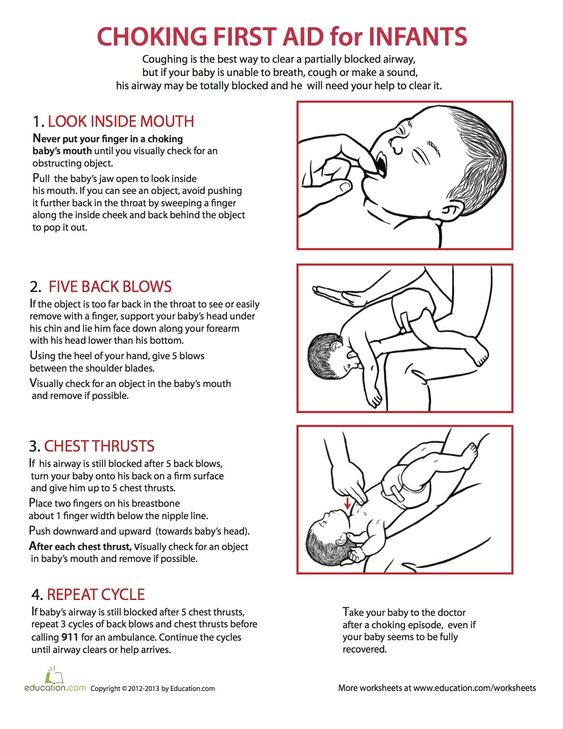
  2. Give up to 5 back blows:
    • Hold the baby face down on your forearm, supporting the head and neck.
    • Deliver 5 firm back blows between the shoulder blades with the heel of your hand.
  3. Give up to 5 chest thrusts:
    • Turn the baby face up, still supporting the head.
    • Place two fingers in the center of the chest, just below the nipple line.
    • Push down about 1.5 inches, quickly and firmly, up to 5 times.
  4. Alternate between 5 back blows and 5 chest thrusts until the object is expelled.
  5. If the baby becomes unresponsive, begin CPR and continue until help arrives.
Choking First Aid for Infants

Preventing Choking in Infants

Parents and caregivers can help reduce choking risk by making safe choices every day:

  1. Bottle feeding safely
    • Always hold your baby during feeds—never prop a bottle with pillows or devices.
    • Make sure the nipple flow is correct for your baby’s age; too fast a flow can overwhelm them.
  2. Choosing developmentally appropriate foods
    • Wait until your baby shows signs of readiness (usually around 6 months) before introducing solids.
    • Offer smooth, soft foods when starting solids. Avoid round, hard, or sticky foods such as hot dogs, grapes, popcorn, raw vegetables, nuts, and chunks of cheese until at least age 4.
    • Cut food into very small pieces—no larger than half an inch—once finger foods are appropriate.
  3. Creating a safe environment
    • Keep coins, buttons, small toys, batteries, and other objects that could fit through a toilet paper roll out of reach.
    • Get down on the floor at baby’s level to spot choking hazards you might otherwise miss.

Key Takeaway

Choking is a leading cause of injury in infants, but it doesn’t have to be. Parents and caregivers can prevent most choking incidents by supervising feeds, offering age-appropriate foods, keeping small objects out of reach, and knowing what to do in an emergency. Learning Infant CPR and First Aid before your baby arrives is one of the best ways to keep your child safe.

Read our Essential Guide: How To Prepare Your Home for a Newborn for more safety guidelines and tips.

What’s a Night Nanny? Roles, Benefits, Costs and How They Help Families

A night nanny (sometimes called a newborn care specialist, night doula or postpartum doula) provides overnight support for new parents by caring for the baby during the night and helping families get restorative sleep. If you’re a new parent wondering “What’s a night nanny? Do I need one?” this guide explains what they do, how they support breastfeeding, what to expect during a typical overnight shift, the costs and how to choose the right kind of newborn care.

What's a Night Nanny?

What’s a Night Nanny?

A night nanny is a caregiver who provides overnight support for newborns and their parents, helping babies sleep safely and giving parents restorative rest. Beyond hands-on care, night nannies offer evidence-based guidance and support to ensure parents feel confident in making safe, informed decisions for their baby. Night nannies can also be known as postpartum doulas, newborn care specialists, night doulas and baby nurses. The title Nurse is legally protected in most states and should only be used by a licensed Nurse (RN, LPN, LVN). The other titles, however, describe similar support roles for families in the postpartum phase though credentials vary across providers. Families may want to check the National NAPS Registry for Night Doulas to verify training and standards.

What Does a Night Nanny Do Overnight?

So, what exactly does a night nanny (or night doula) do overnight? In practice, their role goes far beyond simply “watching the baby.” They combine hands-on newborn care, household support and evidence-based guidance for parents, helping the whole family rest, recover, and thrive during those critical first weeks.

Typical responsibilities during an overnight shift include:

  • Newborn care: Feeding, diapering, swaddling, soothing and monitoring the baby throughout the night. Night doulas also help with common issues such as helping baby transition to the crib or learning to take a bottle, rather than breastfeed overnight.
  • Breastfeeding support:  If you’re breastfeeding, the night doula brings baby to you for nursing, then manages burping, diapering and settling afterward. This support can even help parents get more sleep while breastfeeding. Doing all of the post-breastfeeding care of baby ensures you get more sleep. If you’re pumping, night nannies assist by cleaning and sterilizing pump parts and ensuring safe handling and storage of milk.
  • Bottlefeeding Support: Safe formula prep, bottle cleaning/sterilization and A night doula can also help wean overnight bottle feeds or get baby used to feeding from a bottle.
  • Sleep support and routines:  Many parents ask “when will my baby sleep through the night”? and while only your baby truly knows, a night doula can gently help infant learn healthy sleep habits and support longer stretches of sleep. This is especially helpful for parents who want to get newborn twins on the same schedule.
  • Household tasks: In addition to tasks related to bottles, making formula and pumping, a night nanny also keeps a clear and organized nursery and ensures baby supplies are ready for the morning.
  • Parental education: Sharing research-backed guidance on infant safety, feeding, diapering and sleep routines, giving parents confidence in their newborn care
  • Emotional and partner support: Offering a calm, nonjudgmental presence and education about normal postpartum mood changes so families understand the difference between PPD and the “Baby Blues
  • Documentation: Logging feeds, diaper changes, sleep patterns, and milestones using tools like the LMS Live app or another baby-tracking system. This is especially helpful for twins and multiples.

The ultimate goal is simple: restorative sleep for parents and safe, nurturing care for the baby with ongoing guidance and support grounded in the latest evidence. By morning, parents wake up to a fed, settled baby and a home ready for the day.

Who Hires Postpartum Doulas and Night Nannies?

There’s no “one size fits all” reason parents hire overnight postpartum care. In most other countries, new parents receive community or government support. In the U.S., with families spread out and many jobs not offering paid maternity leave, it makes sense that parents sometimes need a helping hand.

While sometimes the reason is as simple as, “I just ran the equivalent of a marathon, and at the finish line they handed me baby,” here are some of the most common reasons families hire overnight newborn care:

  • Limited time off: Parents are up against the clock of maternity leave and need restorative sleep to function at work.
  • Other children or family responsibilities: Parents want to be present for older children or manage household responsibilities during the day.
  • No nearby family support: Parents may live far from or simply don’t have relatives who are available to help overnight.
  • Multiples: Twins or higher-order multiples often require 20–24 feeding and diapering sessions per day. It makes sense that weeks worth of 24 hour care without a break leads to sleep deprivation, and then illness or exhaustion.
  • Post-NICU care: Babies returning home from the NICU often need extra overnight support, especially if maternity leave was exhausted during the hospitalization.
  • Infant Sleep Support: Lots of parents wonder things like how to stop swaddling, how to help a baby whose days and nights are mixed up or how to help an infant sleep independently. If this sounds like you, Night Nurses Answer Your Infant Sleep Questions might help you right now!
  • Mental and physical health support: Postpartum mood and anxiety disorders can affect any parent. Restorative overnight care helps prevent exhaustion, supports mental health and allows parents to recover physically

If you’re considering night nanny care, you can prepare to talk with a potential caregiver by reading What Should I ask a Night Nurse?

Video: What’s a Night Nanny?

How Night Nannies and Doulas Support Breastfeeding

In the early nights after birth when baby is likely feeding every 2-3 hours a night nanny offers lactation support through your breastfeeding session to ensure nursing is off to a successful start. Then we’ll provide all care after baby has nursed doing the diaper changing, burping, diapering and swaddling back to bed. The goal is for parents to never get out of bed, maximizing post-birth recuperation. Many times parents and night doulas will text each other when it’s time to nurse.

As the weeks go on and you’re able to have a “stash” of breastmilk for overnight feeds, an overnight caregiver can use this pumped milk for overnight feeds or continue to bring baby to you. As baby becomes more alert, usually around week 6, the newborn caregiver will be up and caring for baby during the wakeful overnight periods. This equates to about 2-3 more hours of sleep for parents when nursing.

Night Nanny vs. Baby Nurse: What’s the Difference?

Baby Nurse is a phrase that comes from the ancient practice of wet nursing, where others would breastfeed baby when a mother could not, or would not, nurse. Formula was not yet available. The reasons why wet nursing was normal practice throughout history are worth reading, and as such an ingrained part of so many cultures. So it makes sense that “baby nurse” is still used today. In our modern times though, the title of Nurse is legally protected in most states and should be used by licensed Registered Nurses, Practical Nurses and Vocational Nurses.

When Is a Registered Nurse Needed Overnight?

Licensed Night Nurse (RN/LPN/LVN) care is appropriate when there is a medical need for care of the child. Common reasons for this in the home include: using feeding tubes or other medical devices, giving prescribed medications to baby or when a child has a chronic or complex medical condition.

We often think of Mother/Baby Nurses as being helpful to newborns, but they are equally valuable for parents. While most birth mothers don’t see their OB until about six weeks postpartum, checkups within the first 7–10 days at home can catch small issues before they become big problems. Additionally, Postpartum Mood and Anxiety Disorders (PMADs) are the most common complication of pregnancy and can affect both parents. Nurses cannot diagnose these conditions, but they can provide screenings and recommend follow-up care if needed. In addition, a maternity nurse can monitor physical recovery, including suture healing, blood loss, and overall well-being.

Does Insurance Cover my Night Doula?

In most cases, non-medical night doula or night nanny care is an out-of-pocket expense. However, coverage options are expanding as more insurers and employers recognize the importance of postpartum support.

Here are a few possibilities to explore:

  • Private insurance: Some insurers may reimburse part of postpartum doula care, especially when billed under “lactation support” or “postpartum visits.” Coverage varies widely, so it’s best to call your provider directly.
  • Licensed nursing care: If overnight care is provided by a Registered Nurse (RN, LPN, LVN) for a medically necessary reason—such as pediatric monitoring after a NICU stay—insurance is more likely to cover services with a doctor’s referral.
  • Employer benefits: A growing number of companies include postpartum doula or newborn care in employee benefit programs.
  • Financing & Baby Registries: Let Mommy Sleep offers pay-over-time or financing options. Parents can also add postpartum services to baby registries through platforms like BabyList.

While it’s not guaranteed, it’s worth checking with your insurance provider, employer, or benefits administrator. Even when insurance doesn’t cover services directly, families have more creative payment options than ever before. Here are some detailed strategies on how to get insurance to cover my night nanny.

How to Decide if You Need Overnight Newborn Care

If you’re wondering, “Do I really need a night nurse?” the answer often depends on your family’s circumstances. Some parents hire overnight newborn care simply for peace of mind, while others find it’s the only way to safely recover and function during the day.

You may benefit from a night nanny, newborn care specialist or postpartum doula if:

  • You’re returning to work soon and need healthy, restorative sleep to function.
  • You don’t have nearby family or consistent overnight support.
  • recovering from a C-section, complicated birth or balancing an ongoing health condition with being a brand new parent.
  • caring for newborn twins or higher order multiples, which can mean 20+ feeds and diaper changes every 24 hours.
  • Your baby is coming home from the NICU and you want expert, evidence-based support as you adjust.
  • You or your partner are struggling with postpartum anxiety, depression or overwhelming fatigue.
  • You’d like guidance on safe sleep, feeding and newborn routines from someone trained in evidence-based care.
  • Helping baby sleep through the night without “crying it out” is important to your family.
  • You simply want peace of mind knowing your baby is safe and gently cared for overnight.

What’s a Night Nanny? Final Thoughts

While it’s often portrayed as one in the media, overnight newborn care isn’t a luxury. It’s a way to protect your health, safeguard your baby’s well-being, and make the early weeks of parenthood more sustainable. For many families, the investment in sleep and expert support pays off in confidence, recovery, and a smoother transition into life with a newborn.

If you’d like to meet a night doula or are still wondering, “What’s a Night Nanny?”, please reach out. We’re here to help!

Erin Thomas Walker & Chicago’s Best Postpartum Doula Agency

updated, October 13, 2025 – Meet Erin Thomas Walker,  postpartum doula, Peer Breastfeeding Specialist and head of overnight infant care at Let Mommy Sleep Chicago. A resident of Elmhurst, IL and mother of 3, Erin’s compassion and understanding of working families keeps her connected to LMS families.

Why families in Chicagoland choose Let Mommy Sleep Chicago:
We are not just another babysitter directory or ad-hoc night help. At LMS Chicago, we specialize in overnight care for newborns and infants, staffed by certified night nurses, newborn-care specialists and postpartum doulas who are trained in infant safe sleep, developmental sleep cycles and understand the particular rhythms of Chicagoland families. Learn more about our qualifications in Introducing the National NAPS Registry for Night Doulas.

Regina was fantastic and extremely qualified. We’re so grateful to her and Let Mommy Sleep.

MM in St. Charles
Proud To Be A Cribs For Kids Safe Sleep Partner!

Chicago’s Best Postpartum Doula Agency- Parent FAQ’s

There are a lot of terms for caregivers who support newborns and parents in the home; night doula, newborn care specialist, night nanny or even baby nurse. Below are parent FAQ’s about each baby care specialty, from safe sleep to night nurses.

What do night nannies or night nurses actually do?

A night nanny in Chicago provides overnight newborn care: feeding, soothing, diaper changes and infant sleep support, so parents can rest. Let Mommy Sleep Chicago caregivers are vaccinated, certified in newborn care, CPR/First Aid, and infant sleep safety. Learn more in What’s a Night Nanny? Roles, Benefits, Costs and How They Help Families

How much does a night nanny cost in Chicago?

Night nanny rates in Chicago typically range from $38–$55 per hour, depending on caregiver credentials, multiples, and medical considerations. Most families book 8–10 hour overnight shifts. Let Mommy Sleep Chicago offers flexible scheduling and package options.

What is infant sleep safety in Chicago or Illinois?

In Illinois, safe sleep means placing your baby on their back in a flat, firm crib with no blankets or toys. Let Mommy Sleep Chicago follows these American Academy of Pediatrics guidelines to prevent SIDS and promote healthy sleep for newborns. We are also Proud To Be A Cribs For Kids Safe Sleep Partner! Illinois safe sleep is AAP safe sleep.

Learn the 10 Steps to Safe Sleep for Baby.

How do I hire a newborn care specialist in Chicago?

To hire a newborn care specialist in Chicago, look for verified professionals with infant CPR, First Aid, and newborn safety certifications. Let Mommy Sleep Chicago screens and trains all caregivers in infant safe sleep and evidence-based practice, ensuring trusted, overnight newborn care in your home.

When should I start sleep training my baby?

Most babies are ready for gentle sleep training around four to six months old. Let Mommy Sleep Chicago helps parents choose methods that fit their baby’s temperament, ensuring consistent naps, longer stretches of sleep and less nighttime stress. If you’re ready now, read the Ultimate Guide to Baby Sleep Training.

Are there baby sleep consultants in Chicago?

Yes. Let Mommy Sleep Chicago offers sleep consultants who create customized sleep plans for newborns and infants. Parents receive step-by-step guidance to reduce night wakings and build healthy sleep habits from day one. This is a free part of our night nanny service.

Chicago’s Best Postpartum Doula Agency Since 2020

With a minimum of 5 years of infant care experience and sparkling Google reviews, Let Mommy Sleep Chicago newborn care providers allow parents to have peace of mind overnight. As Erin says, “When you do what you love, they say you never work a day in your life!”

For newborn and postpartum care services you can reach out here.

Meet Erin Thomas Walker, postpartum doula and night nanny
Meet Erin

Now Serving: Grayslake, Libertyville, Lake Zurich, Vernon Hills, Buffalo Grove, Wheeling, Palatine, Barrington, Arlington Heights, Des Plains, Park Ridge, Morton Grove, Wheaton, Naperville, Downers Grove, Elmhurst, Oak Brook, Hoffman Estates, Lombard, Carol Stream, Hinsdale, Western Springs, Winfield, Deerfield, Northbrook, Northfield, Glenview, Evanston, Wilmette, Kenilworth, Winnetka, Highland Park, Lake Forest, Lake Bluff, Deer Park, Oak Park, River Forest, Lincoln Park, Lake View, Logan Square, Edgewater, Rogers Park, Lincolnwood, Bucktown, Uptown, Downtown, Lincoln Square, Wicker Park, West Loop, South Loop, The Loop, Streeterville, River North, Old Town, Gold Coast, Mayfair, Andersonville, Ravenswood, Irving Park, Glen Ellyn, Glencoe, La Grange and Schaumburg 

Selling Your Home with Babies and Kids

Are you thinking about selling your home with young children in tow?  Award-winning realtor and mother of two, Kamber Petty shares her favorite tips to make the process a little less stressful in Selling Your Home with Babies and Kids. Updated for 2022!

Selling Your Home with Babies and Kids
Selling Your Home

Selling Your Home with Babies and Kids

Yes it’s true that the real estate market is hot, but that doesn’t make it any less stressful…especially for parents with young children! These tips can help:

·  Obtain an agent that fits your style.  You need an agent that understands your current situation. Parents of young children need to find a realtor that recognizes that a short and to the point email or text is often the best way to communicate.  An agent is there to serve you, and you need to find one that best serves your family’s needs.

· Set up a plan. Before the home goes on the market, decide on the steps you are going to take to keep the home presentable. How you will handle showings, and secure pets for example.

·  Remember that kids come with lots toys and accessories. Aim to pack up about half of the toys to put in storage.  You were going to have to pack them up when you move anyway, so why not do it now? The kids won’t miss the toys, and it makes tiding up before home showings a lot easier. Plus, the kids will enjoy opening up the boxes when it’s time. 

·  Infants come with lots of gear too!  Buyers are not going to think less of you if there are bassinets, play mats and swings around. Most of the baby gear on the market today can be folded up for easy storage anyway. So as long as they are not blocking walkways or making a room feel cluttered, it’s okay to leave gear out.

·  Scheduled Showings:  Make sure agents can schedule online to see the home. The Listing Agent can set up the showings to give you a 4, 2 or 1-hour notice so you don’t have to scramble to get the home ready.  Create a place to put away items quickly, so that showings can be done on short notice. Even kids as young as toddlers can help pick-up toys to put in a big basket in a family room before an agent arrives with prospective homebuyers. Get the kids involved for sure!

About the Author:

Kamber Petty is a mom to two very active boys and a successful Realtor. Kamber has garnered the NVAR Top Producing Club, Platinum Member Award. When you can’t find her showing homes or meeting clients, you can find her on the baseball field with her two middle school boys.  

Did you know you can write a relevant post too simply by supporting Mission Sleep?! Mission Sleep is our 501c3 nonprofit. We provide care for military & 1st responder families whose newborns arrive when a parent is deployed, wounded or deceased.

529 College Savings

updated, December 27, 2023 – Patricia Roberts is Chief Operating Officer at Gift of College, Inc., and author of Route 529: A Parents Guide to Saving for College. Patricia is on a mission to educate new parents about the value of planning ahead! Opening a 529 college savings account before your newborn arrives, or soon thereafter is something you’ll appreciate for years.

There are several important reasons to start saving for college when your baby is born including: the power of compounding, great tax benefits and making it easy for friends and family to contribute whenever they can.

529 College Savings – Financial Benefits

  • The power of compounding The earlier parents can open a college savings account for their child’s future, the more time there will be for even small contributions to compound and grow in value. This means you earn interest on the money initially invested, plus you earn interest on the interest!
  • Tax benefits – Earnings on 529 accounts are not taxed! They are never taxed when withdrawn to pay for a wide range of higher education expenses, well beyond traditional college. Also, 35 states and the District of Columbia offer an annual tax deduction or credit for contributions to 529 college savings plan accounts. 
  • It’s easy for friends and family to contribute. Once an account is opened, parents can invite others to contribute. Rather than giving gifts that are quickly outgrown for birthdays for example, 529 contributions are truly used. Most 529 plans have online tools which enable invitations to be sent by account owners. Creating a circle of support for a child’s education can be a beautiful tradition.  
529 College Savings

How to Get a 529 College Savings Plan Started

Every state offers a 529 plan, but each state is a little different so your first step is to Google your state and “529 plan” together. The plans will include information for you to consider such as:

  • Possible fees related to initial enrollment, annual maintenance or minimum contribution amounts.
  • Tax deductions or credit for contributions available in your state
  • professionally managed 529’s versus plans sold directly from your state to you

You’ll need your baby’s date of birth and Social Security number to start a 529. It’s okay if you need to wait for their social security number, you can start the account yourself and then transfer it. Parents of newborns and infants, especially parents of twins, have a lot on their plates. Establishing a 529 account early in your child’s life creates peace of mind. College is often the most significant investments as a family. Any amount saved will be that much less that a child will need to borrow and repay with interest.