By 10 months, your baby’s sleep habits are beginning to feel more predictable and you might be considering helping baby sleep through the night . Here’s how to set up a flexible, evidence-based schedule that supports consistent naps and long stretches of nighttime sleep. Baby Sleep Schedule for a 10-11 Month Old provides a sample to get started.
Baby Sleep Schedule for a 10-11 Month Old
10 Month Old
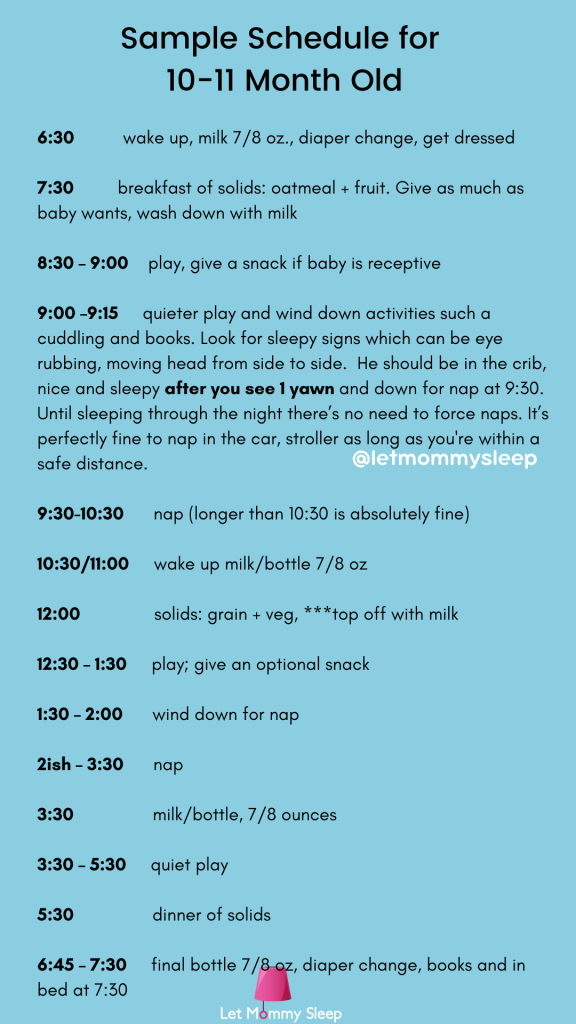
Sample Sleep Schedule for a 10-11 Month Old
Here’s what a typical day looks like for a 10-11 month old baby. You can also customize this schedule to reflect your own daily routine. For example, if baby wakes at 7:00a, simply note that and adjust this schedule forward 1/2 hour.
Time
Activity
Details & Notes
6:30 AM
Wake up, diaper change, bottle
7–8 oz milk or formula
7:30 AM
Optional feed
6–8 oz if baby shows hunger cues
8:00 AM
Breakfast
Solids + milk; oatmeal with fruit is great — milk mixed into food counts toward the 28–32 oz total goal
8:30–9:00 AM
Playtime
Light activity, floor play, songs
9:00–9:15 AM
Wind-down
Quiet play, cuddles, books — watch for sleepy cues like yawning or rubbing eyes
9:30–10:30 AM
Morning nap
1-hour nap; sleeping past 10 AM is fine
10:30/11:00 AM
Wake & bottle
7–8 oz milk or formula
12:00 PM
Lunch
Solids + milk or formula as a drink
12:30–1:30 PM
Playtime
Active play or outdoor stroll
1:30–2:00 PM
Wind-down
Dim lights, read, cuddle
2:00–3:30 PM
Afternoon nap
1–1.5 hour nap
3:30 PM
Bottle
7–8 oz milk or formula
3:30–5:30 PM
Playtime
Low-key play; stay home if sleep training for consistency
5:30 PM
Dinner
Solids + milk or formula
6:45–7:30 PM
Bedtime routine
Bath, bottle (final 6–8 oz), quiet play, lights dim — in bed by 7:30 PM
10-11 month old infant schedule
Notes:
Total daily milk intake for most full-term 10-11 month olds: 28–32 ounces
Most babies this age take 2 naps per day, lasting 1–1.5 hours each.
Adjust the start time forward or backward based on when your baby naturally wakes.
Bedtime can shift earlier if the second nap is short or skipped.
Once you get the pediatrician’s approval and you are sure baby is not waking overnight due to hunger, you can begin sleep training. If you want to help your baby sleep through the night, you can find step-by-step sleep training instructions in the Ultimate Guide to Baby Sleep Training.
FAQ: Baby Sleep Schedule for 10–11 Month Olds
How many naps should a 10–11 month old take? Most babies take two naps per day at this age, one in the mid morning and one in the early afternoon. 10am and 2pm are fairly common but by no means the norm for every baby. By 11 months, some babies may begin resisting the morning nap, signaling the eventual transition to one nap per day closer to 12–14 months.
How long should naps be at 10–11 months? Each nap typically lasts 1 to 1.5 hours, for a total of 2.5–3 hours of daytime sleep. If one nap runs long, the other may naturally shorten. Nap times can also be affected but what activities you and baby are doing during the day.
What time should a 10–11 month old go to bed? A consistent bedtime between 6:30 and 7:30 p.m. works well for most babies. An earlier bedtime may be needed if naps were short or skipped that day.
How much total sleep does a 10–11 month old need in 24 hours? On average, babies this age sleep about 13–14 hours total; 11–12 hours overnight plus 2–3 hours during the day. Every baby’s sleep need varies slightly depending on growth, temperament and activity level.
Why does my 10–11 month old suddenly fight sleep? It can be caused by new mobility like cruising or walking, separation anxiety or teething. Stay consistent with your bedtime routine, and it usually passes within 2–3 weeks.
Can I start sleep training at 10 months old? Yes, if your pediatrician has ruled out medical issues and confirmed your baby is ready. Many families use gentle methods like the Slingshot approach, which allows you to stay near your baby while they learn to fall asleep independently.
Should I still do a dreamfeed at 10 months? Once babies consistently consume 28–32 ounces between the time they wake and bedtime ad can sleep 8-10 hours without needing to feed, a dreamfeed is not needed. If your baby is 10 months old and still only drinks small amounts during daytime feeds, talk to your pediatrician before stopping a dreamfeed.
What if my baby still wakes up at night? Night wakings can still happen due to teething, growth spurts, developmental leaps or simply because baby has never done it any other way. Offer reassurance without full playtime or bright lights, so baby understands it’s still nighttime and time for sleep.
Things to remember:
This is just an example. It’s fine if your schedule differs; the goal is to have defined eating times to set the stage for long sleep overnight.
While your baby is getting more mobile, Infant Safe Sleep guidelines are still important for babies age 0-1 year old. Review them in 10 Steps to Safe Sleep for Baby
This information is for general educational purposes and not a substitute for medical advice. Always follow your pediatrician’s guidance about your baby’s individual feeding and sleep needs.
{
“@context”: “https://schema.org”,
“@graph”: [
{
“@type”: “BreadcrumbList”,
“@id”: “https://www.letmommysleep.com/#breadcrumb”,
“itemListElement”: [
{
“@type”: “ListItem”,
“position”: 1,
“name”: “Home”,
“item”: “https://www.letmommysleep.com/”
},
{
“@type”: “ListItem”,
“position”: 2,
“name”: “Baby Sleep Schedules”,
“item”: “https://letmommysleep.com/blog/category/infant-toddler-sleep/”
},
{
“@type”: “ListItem”,
“position”: 3,
“name”: “10–11 Month Sleep Schedule”,
“item”: “https://letmommysleep.com/blog/2022/01/22/baby-sleep-schedule-10-month-old/”
}
]
},
{
“@type”: [“MedicalWebPage”, “Article”, “FAQPage”],
“@id”: “https://letmommysleep.com/blog/2022/01/22/baby-sleep-schedule-10-month-old/”,
“mainEntityOfPage”: “https://letmommysleep.com/blog/2022/01/22/baby-sleep-schedule-10-month-old/”,
“url”: “https://letmommysleep.com/blog/2022/01/22/baby-sleep-schedule-10-month-old/”,
“headline”: “Baby Sleep Schedule for a 10–11 Month Old”,
“description”: “A sample evidence-based sleep schedule for 10–11 month old babies, including feeding, naps, bedtime routines, and expert answers to common sleep questions.”,
“author”: {
“@type”: “Organization”,
“name”: “Let Mommy Sleep”,
“url”: “https://www.letmommysleep.com”
},
“publisher”: {
“@type”: “Organization”,
“name”: “Let Mommy Sleep”,
“logo”: {
“@type”: “ImageObject”,
“url”: “https://www.letmommysleep.com/images/logo.png”
}
},
“about”: {
“@type”: “MedicalCondition”,
“name”: “Infant Sleep”,
“description”: “Normal infant sleep patterns and routines for babies 10–11 months old.”
},
“datePublished”: “2025-11-08”,
“dateModified”: “2025-11-08”,
“speakable”: {
“@type”: “SpeakableSpecification”,
“xpath”: [
“/html/head/title”,
“/html/body//h1”,
“/html/body//h2[contains(text(),’Sample Sleep Schedule’)]”,
“/html/body//ol[@id=’schedule-steps’]”
]
},
“video”: {
“@type”: “VideoObject”,
“name”: “10–11 Month Baby Sleep Schedule Explained”,
“description”: “A pediatric RN walks you through the 10–11 month baby sleep schedule step-by-step.”,
“thumbnailUrl”: “https://letmommysleep.com/blog/storage/2023/08/10-11.jpg”,
“uploadDate”: “2025-11-08”,
“contentUrl”: “https://www.letmommysleep.com/videos/10-month-sleep-schedule.mp4”,
“embedUrl”: “https://www.youtube.com/watch?v=letmommysleep10month”
},
“mainEntity”: [
{
“@type”: “HowTo”,
“name”: “Step-by-Step Baby Sleep Schedule for 10–11 Month Olds”,
“description”: “A flexible, evidence-based guide to setting up your 10–11 month old’s sleep schedule.”,
“totalTime”: “PT24H”,
“supply”: [
{
“@type”: “HowToSupply”,
“name”: “Formula or breastmilk (28–32 oz total daily)”
},
{
“@type”: “HowToSupply”,
“name”: “Solids (3 meals per day)”
}
],
“step”: [
{
“@type”: “HowToStep”,
“position”: 1,
“name”: “6:30 AM – Wake up, diaper change, bottle”,
“text”: “Offer 7–8 oz of milk or formula after baby wakes up and has a diaper change.”
},
{
“@type”: “HowToStep”,
“position”: 2,
“name”: “8:00 AM – Breakfast”,
“text”: “Serve oatmeal with fruit and milk mixed in. Counts toward total milk intake.”
},
{
“@type”: “HowToStep”,
“position”: 3,
“name”: “9:30–10:30 AM – Morning nap”,
“text”: “Put baby down for a 1-hour nap once sleepy cues appear.”
},
{
“@type”: “HowToStep”,
“position”: 4,
“name”: “12:00 PM – Lunch and Playtime”,
“text”: “Offer solids plus milk or formula. Follow with active play or outdoor stroll.”
},
{
“@type”: “HowToStep”,
“position”: 5,
“name”: “2:00–3:30 PM – Afternoon nap”,
“text”: “1–1.5 hours of rest; adjust based on baby’s cues and activity level.”
},
{
“@type”: “HowToStep”,
“position”: 6,
“name”: “6:45–7:30 PM – Bedtime routine”,
“text”: “Bath, final 6–8 oz bottle, lights dim, quiet play, and in bed by 7:30 PM.”
}
]
},
{
“@type”: “FAQPage”,
“mainEntity”: [
{
“@type”: “Question”,
“name”: “How many naps should a 10–11 month old take?”,
“acceptedAnswer”: {
“@type”: “Answer”,
“text”: “Most 10–11 month olds take two naps per day—one mid-morning and one early afternoon. Some babies begin to resist the morning nap closer to 12 months.”
}
},
{
“@type”: “Question”,
“name”: “How long should naps be at 10–11 months?”,
“acceptedAnswer”: {
“@type”: “Answer”,
“text”: “Each nap lasts about 1–1.5 hours for a total of 2.5–3 hours of daytime sleep.”
}
},
{
“@type”: “Question”,
“name”: “What time should a 10–11 month old go to bed?”,
“acceptedAnswer”: {
“@type”: “Answer”,
“text”: “A bedtime between 6:30 and 7:30 p.m. works best. Move bedtime earlier if naps were short or skipped.”
}
},
{
“@type”: “Question”,
“name”: “How much total sleep does a 10–11 month old need in 24 hours?”,
“acceptedAnswer”: {
“@type”: “Answer”,
“text”: “Babies this age average 13–14 hours of total sleep: about 11–12 hours at night and 2–3 hours during the day.”
}
},
{
“@type”: “Question”,
“name”: “Why does my 10–11 month old suddenly fight sleep?”,
“acceptedAnswer”: {
“@type”: “Answer”,
“text”: “New mobility, separation anxiety, or teething can disrupt sleep. Stay consistent with your bedtime routine and it typically resolves in 2–3 weeks.”
}
},
{
“@type”: “Question”,
“name”: “Can I start sleep training at 10 months old?”,
“acceptedAnswer”: {
“@type”: “Answer”,
“text”: “Yes, once your pediatrician confirms your baby is ready. Gentle methods like the Slingshot approach allow parents to stay near while baby learns to self-soothe.”
}
},
{
“@type”: “Question”,
“name”: “Should I still do a dreamfeed at 10 months?”,
“acceptedAnswer”: {
“@type”: “Answer”,
“text”: “If baby consumes 28–32 oz during the day and sleeps 8–10 hours, a dreamfeed isn’t necessary. Consult your pediatrician before dropping it.”
}
},
{
“@type”: “Question”,
“name”: “What if my baby still wakes at night?”,
“acceptedAnswer”: {
“@type”: “Answer”,
“text”: “Night wakings can result from teething, growth spurts, or habit. Keep lights low and avoid playtime so baby learns it’s still time for sleep.”
}
}
]
}
]
}
]
}
Newborns and infants sleep differently than adults. Once you understand why, you can work with their natural rhythms instead of against them, helping them sleep longer and with less fuss.
They’re tiny! – Newborns have small stomachs so they need to eat frequently. Their tummies can only hold small amounts of breast milk or formula and this nutrition gets digested quickly. As a result, they typically wake every 2 to 3 hours to feed. See the chart at How big is a newborn’s stomach?
Hunger, need for comfort or growth spurts – Babies usually wake up if they’re hungry, have a wet or dirty diaper, or are experiencing discomfort due to issues like teething or gas. Additionally periods of growth mean their bodies and brains are developing rapidly, leading to more frequent waking during the night.
Immature sleep patterns: Newborns have an immature sleep-wake cycle, and it takes time for their circadian and ultradian rhythms to develop. This means that their sleep is not yet regulated by day and night patterns, and they have shorter sleep cycles compared to adults.
Melatonin isn’t Present Yet: Newborns receive melatonin, widely known as the sleep hormone, from the placenta but don’t start developing their own until they’re about 8-9 weeks old.
Is my infant sleeping enough
Baby Sleep: Naps Decoded – Circadian Rhythm
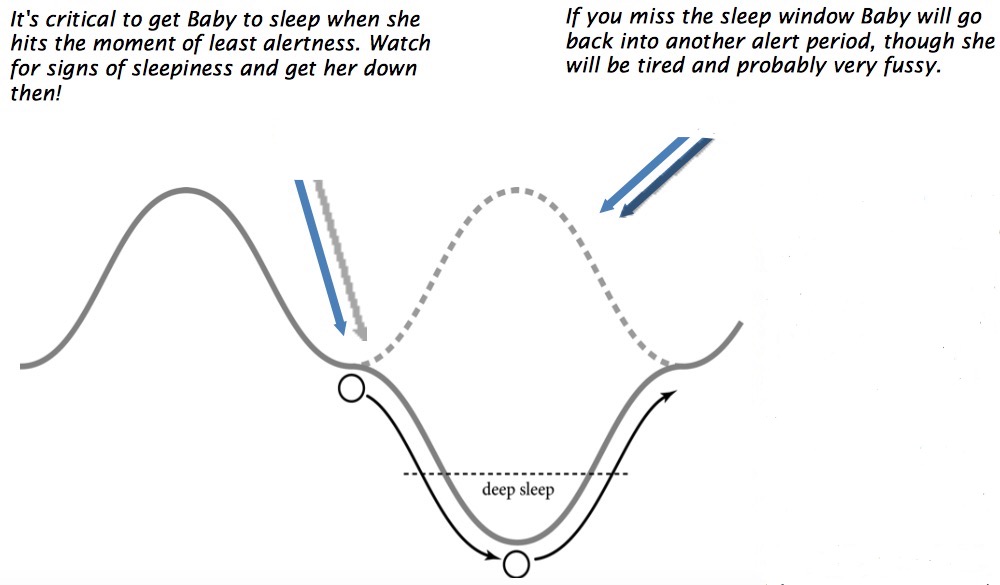
Circadian rhythm is nature’s 24-hour clock that regulates awake and sleep times. Within this cycle are shorter ultradian rhythms, lasting about 30–90 minutes, that dictate when babies move from alertness to sleepiness.
Every baby book about “schedules” or “wake windows” is based on these patterns—but let’s simplify how they actually work.
Ultradian Rhythm Basics
Serotonin increases alertness and is triggered by daylight.
Melatonin promotes sleepiness and is triggered by darkness.
If we visualize this using a 6-month-old as an example: baby is wakeful at the top of the curve (around 45 minutes after waking), and sleepy at the bottom (around 90 minutes after waking). Tip: Put baby in the crib 5–10 minutes before that 90-minute mark—right before the “clock dings” and they become alert again.
In full-term newborns, melatonin production doesn’t mature until 9–12 weeks, so they build up to that 90-minute cycle gradually. Getting baby down before they enter another wakeful period prevents fussiness and overtiredness.
NapTiming Reminder
Baby shouldn’t start winding down at the :30, :45, :60- or 90-minute mark. They should already be in their crib by that point.
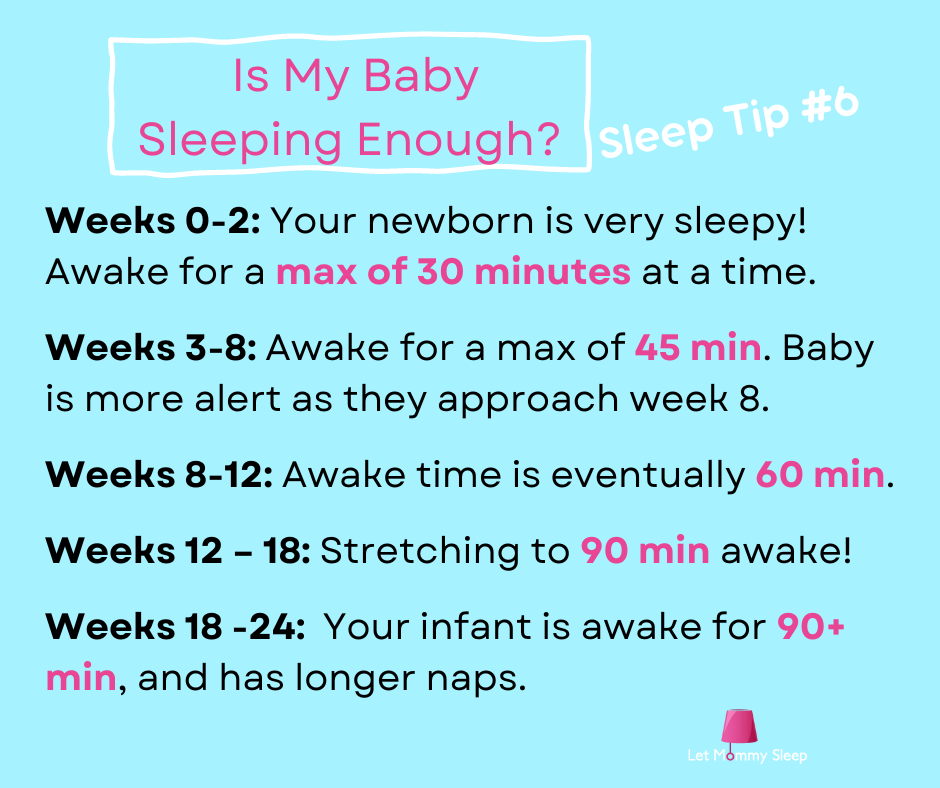
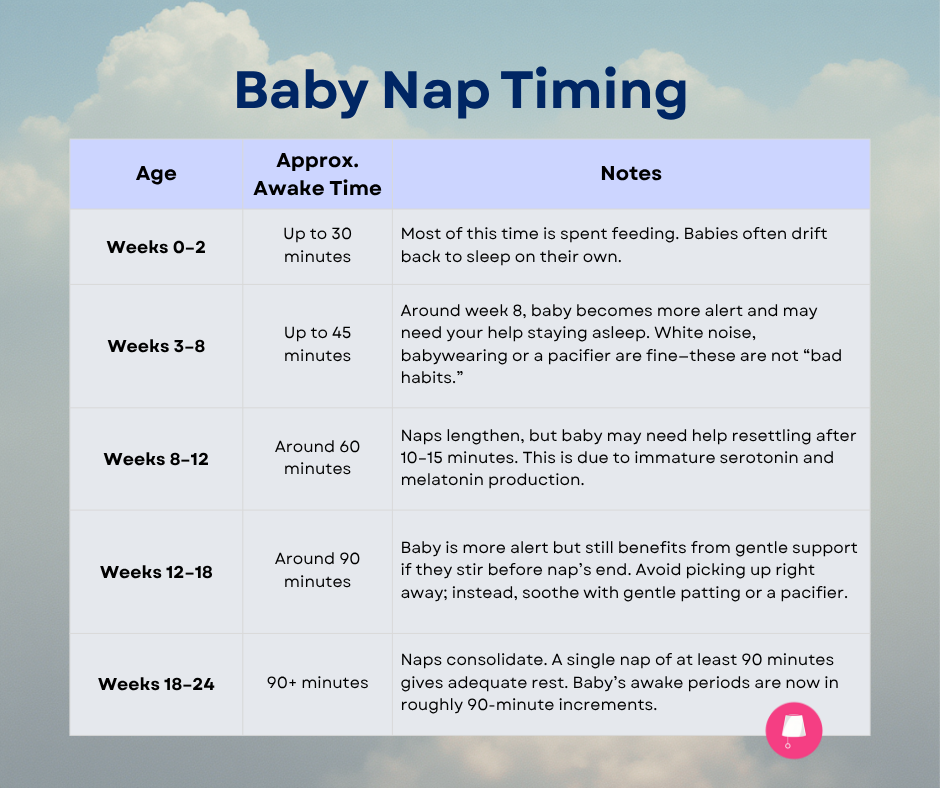
Here’s a breakdown of newborns’ basic awake and sleep times:
Baby Sleep: Naps Decoded
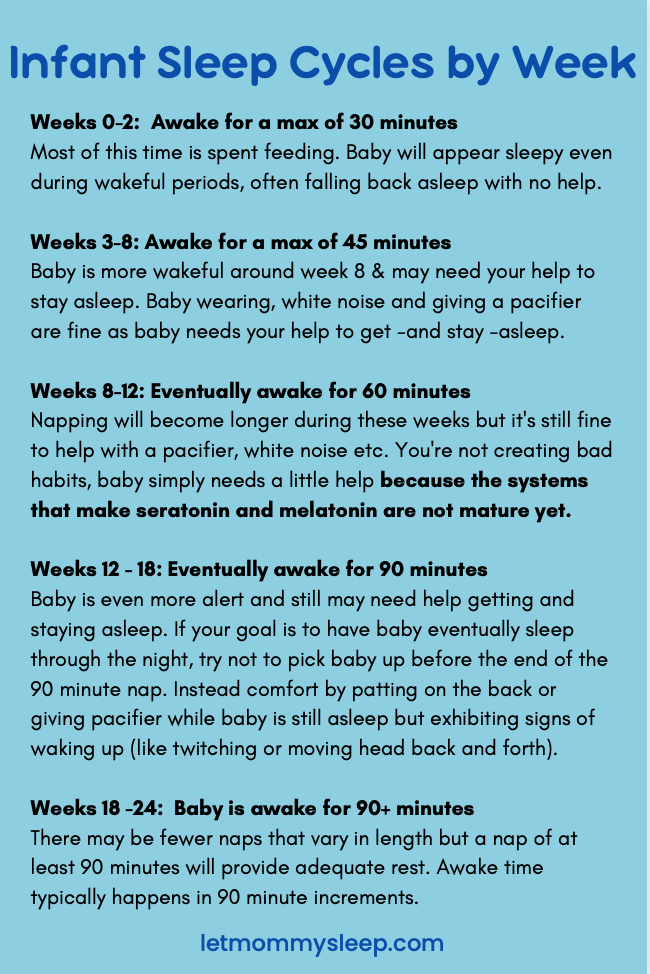
Weeks 0-2: Baby is awake for a maximum of 30 minutes. Most of this time is spent feeding and baby will appear sleepy even during wakeful periods, often falling back asleep with no help at all.
Weeks 3-8: Baby is awake for a maximum of 45 minutes. You’ll notice baby is more wakeful around week 8; s/he won’t just go right back to sleep like s/he used to and may need your help to stay asleep. Baby wearing, white noise, giving a pacifier to help sleep are all fine to do because at this age baby needs your help to get and stay sleep.
Weeks 8-12: Baby is working on and eventually awake for 60 minutes. Napping will become longer during these weeks as well but it’s perfectly fine and even recommended to help baby with napping when s/he pops up after 10-15 minutes or so by giving a pacifier, using white noise etc. You’re not creating bad habits, baby simply needs a little help to not fully awaken because the systems that make seratonin and melatonin are not quite mature yet.
Weeks 12 – 18: Baby is working on and eventually is awake for 90 minutes. Baby is even more alert and still may need help getting and staying asleep. If your goal is to have baby eventually sleep through the night independently, try not to pick baby up if she wakes before a 90 minute nap is done. Instead, stay near to comfort with patting on the back or giving pacifier while baby is still asleep, but exhibiting signs of waking up like twitching or moving her head back and forth.
Weeks 18 -24:Baby is awake for 90+ minutes and consolidates naps now. There may be fewer naps that vary in length but a nap of at least 90 minutes will provide adequate rest. S/he will usually be awake for some increment of 90 minutes (11⁄2 hours, 3 hours, 4 1⁄2 hours).
What’s Next?
If your goal is to have baby sleep long stretches overnight without feeding, the 4 month well check is a great time to start talking with your pediatrician. These longer stretches of sleep are really just one big nap consolidation! They can help you to know whether baby is developmentally ready to sleep for at least 6 hours uninterrupted.
If you’re ready for your baby to sleep through the night, start with an appropriate routine. While the cry-it-out method gets a lot of press, sleeping through the night can be a gradual process where baby’s body adjusts to less milk overnight, making sleep a natural next step to waking from hunger. You can read about this in detail in the Ultimate Guide to Baby Sleep Training.
Infant Sleep Cycles visual
Baby Sleep: Naps Decoded – Important Notes
Sometimes even though we’re doing everything right, babies cry. A LOT.
They might cry because of colic, could be overstimulation, reflux or any other reason only known to your baby. Even if you follow this blog or any sleep advice exactly as it’s written, babies are not robots. You’re doing a great job. If you’re concerned about baby’s crying or health, please contact your pediatrician.
These guidelines are for full-term babies without medical concerns. Preemies, twins, and babies with special feeding or growth needs may follow different patterns. Some babies need to be woken for feeds to gain weight, for example. When in doubt, trust your instincts and your doctor. You can never go wrong with patience, following doctors’ orders and responding to your baby’s needs.
“What should my baby’s schedule look like?” is one of those questions for which there are a lot of right answers and being “on a schedule” is usually just a matter of following baby’s natural cycle. It shouldn’t feel forced or like a stand-off between parent and baby and for some parents the schedule is their first step in helping baby sleep through the night. Below is Sample Schedule for a 4, 5 or 6 Month Old Baby.
5-6 Month Old Baby
Every baby is unique, and while the sample schedule can be a helpful guide, keep in mind that sleep regressions, growth spurts, illness and developmental milestones will naturally affect timing. Also, aways prioritize 10 Steps to Safe Sleep for Baby: place your baby on their back on a firm, flat surface, free of loose bedding, pillows, toys and bumpers. Following these guidelines supports both your baby’s healthy development and your peace of mind.
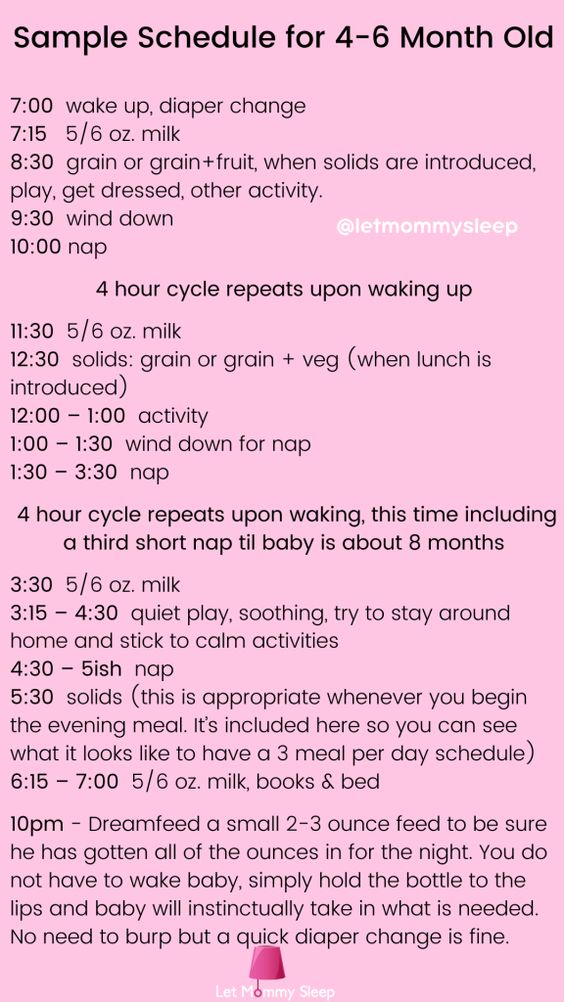
Sample Schedule for a 5-6 Month Old Baby
7:00am wake up, change
7:15 or 7:30 milk/formula given when baby is showing signs of hunger
8:30 solids: grain, or grain + fruit when solids are introduced as directed by your pediatrician. Milk/formula can also be given here.
9:30 wind down to get ready for nap
10:00 down for a nap
– 4 hour cycle repeats upon waking up –
11:30 milk/formula
12:30 solids: grain or grain + veg (when lunch is introduced as directed by pediatrician) Milk/formula can also be given here.
12:00 – 1:00 activity
1:00 – 1:30pm wind down for nap
1:30 – 3:30 nap
– 4 hour cycle repeats again upon waking from nap, but with a third short nap-
3:30 milk/formula
3:30 – 4:30 quiet play, try to stay around home and stick to calm activities
4:30 – 5ish nap
5:30 dinner of solids (this is appropriate whenever you want to begin the addition of an evening meal—we are only including it to show what it looks like to have a 3 meal per day schedule)
6:15 – 7:00 milk/formula, getting into PJ’s, books and quite time and then into bed
10pm Dreamfeed if you wish. Baby does not have to be fully awake for this. It is just a small 2-3 ounce feed to be sure baby has gotten all of the ounces in for the night. You don’t have to wake baby, simply hold the bottle or breast to baby’s lips and they will instinctually take in what’s needed. When you’re done there’s no need to burp since baby is so relaxed but a quick diaper change should be done. You can read this if you’re wondering What is a Dreamfeed?
There will be 3 “blocks” of 4 hours. The last block will only include a short nap since it is close to bedtime.
Each block begins with milk and the last block ends with milk, so feeding times are at: 7am, 11:00am, 3pm and 6:30pm. There may be milk “snacks” in between and at mealtimes, especially for our breastfed babies who do not take in 6 ounces per feed but the 4 main feeding times are the anchor to this schedule.
Baby Schedule FAQs
How do I know if my baby is getting enough milk? Look for steady weight gain, regular wet diapers and contentment after feeds. You can always visit your pediatrician for a weight check too.
What if my baby skips a nap? Occasional skipped naps are normal as babies grow. Try not to force a nap, just keep activities calm and follow your baby’s cues until the next sleep period.
Can I adjust the schedule for breastmilk vs. formula? Yes. Formula-fed babies may feed less often but in larger amounts, while breastfed babies often eat more frequently. It’s perfectly fine to adapt the sample schedule to your baby’s needs.
Sleeping through the Night
If your baby is older and you want another sleep schedule, or you’re ready to help your infant sleep through the night, read the Ultimate Guide to Baby Sleep Training. You can also join us on Reddit to share what works for you or talk through any sleep-troubleshooting.
We hear them at playgroups and baby showers, see them on message boards and read them on medicine bottles. Parental Urban Legends add more confusion to new parents’ already overloaded brains and with no basis in fact, they persist like Mikey and Pop Rocks. Here are our Top 3 Infant Sleep Myths and solutions that work better:
Parental Urban Legends
Myth #1. Putting rice cereal in baby’s bottle will help baby sleep longer
There is absolutely no evidence that shows that thickening milk or formula with cereal will make baby sleep longer at night. In fact, the most cited study on this topic, heartily disproves this parental urban legend.
In our desperation to “tank baby up” and buy an extra hour of rest, it’s often thought that a fuller stomach = more sleep. This is true when we give baby milk before bed to ensure that s/he doesn’t wake unnecessarily from hunger, but the addition of rice cereal to thicken a feed does not help baby sleep longer.
There is also a very real, evidence based movement to completely remove rice cereal from babies’ diet but that is for another post.
Why it’s become a parental urban legend: When parents introduce rice cereal in baby’s bottle, it is typically at the 8-12 week mark, when parents are at their wits end with getting up 3-4 times overnight. The fact is, baby is naturally sleeping longer stretches at this time anyway. Thickening formula receives the credit for what baby is doing naturally.
What to Do to Help Baby Sleep Longer: Time is the real answer to allowing babies to sleep longer stretches at night as the more baby grows, the more food their tummies can hold, keeping hunger from naturally waking them. But there are a few things that actually help newborns and infants sleep more soundly:
White Noise – drown out the noises that can wake baby up and simulate the womb
Slow feeding with lots of opportunities to burp – hold baby upright for at least 20 minutes (longer if your baby experiences reflux) after feeding to be sure no gas is trapped and there’s plenty of time to digest.
Myth #2. Mylicon will Eliminate Gas and Soothe your Baby
This myth is near and dear to my heart because like so many, I desperately believed it myself with my own 3 kids. Study after study definitively demonstrate that Simethicone (the generic name for gas drops) is no more or less effective than a placebo. What does this mean? Gas drops don’t work. Period.
Why it’s become a parental urban legend: EVERYONE recommends Simethicone drops. Everyone! They even have their own little section in the pharmacy department. Once again well-meaning parents just want to help baby find some relief. Please try to contain your shock when I tell you this, but marketing companies love to capitalize on “soothing baby” so they sell, sell, sell a harmless but useless product.
And once again it’s you and your baby who should receive the credit for getting that uncomfortable gas out of baby’s tummy. Slow patient feeds, lots of burping and gently switching position or massaging baby to get gas out after feeding are tried and true ways to reduce gas.
What to Do to Help Eliminate Gas – While drops certainly can’t hurt there are several other options to help baby work out the gas that’s causing troubling:
Once again, slow feeds with lots of opportunity to burp during feeding. If bottle feeding, use the slowest nipple flow.
Probiotics – Probiotics to promote good gut health in baby may be recommended by your pediatrician.
When starting solids, give new foods for breakfast, this way baby’s system has all day to work out any issues that the new food might be causing…and by issues we mean gas! 🙂
Myth #3. Putting babies to sleep later at night means they’ll sleep later in the morning
We’ve all done this one. According to pediatric sleep specialist, Dr. Lisa Meltzer, “the internal clock is a powerful force that typically wakes young children up around the same time every morning, no matter what time they go to sleep at night.” This means that putting baby to sleep later robs them of sleep they should be getting. Even worse, poor night sleep adds to the overtired cycle the next day, making it more difficult for baby to settle and rest again.
Why it’s become a parental urban legend: Because staying up late and then sleeping late seems so logical! And we are desperate for sleep AND logic at this point! Sure there are times babies have a big day and sleep for long stretches out of sheer exhaustion, but this gives us a false positive. Keeping baby awake longer than their bodies need may work for one night or one nap, but fighting against baby’s natural rhythms leads to true exhaustion and meltdown.
What You Can Do Instead– Unfortunately, we can’t fight a baby human’s natural body clock; this one goes in the “this too shall pass” category. Taking turns with your partner or a loving caregiver to handle early wake ups won’t cause baby to sleep later but it will help YOU to sleep later!
We’re often asked about “Getting Baby on a Schedule” here at LMS. While baby’s routine is something that naturally emerges if we follow baby’s lead, it’s understandable that the rest of the family can benefit from predictable feeding and sleep times. Below is a sample schedule for a typical 6/7 month old baby. This is by no means the *only* schedule, and it’s certainly not the best schedule for everyone but if you are looking for a starting point, the Sample Sleep Schedule for a 6-7 Month Old template below is one we often use in Sleep Consultations.
Sample Sleep Schedule
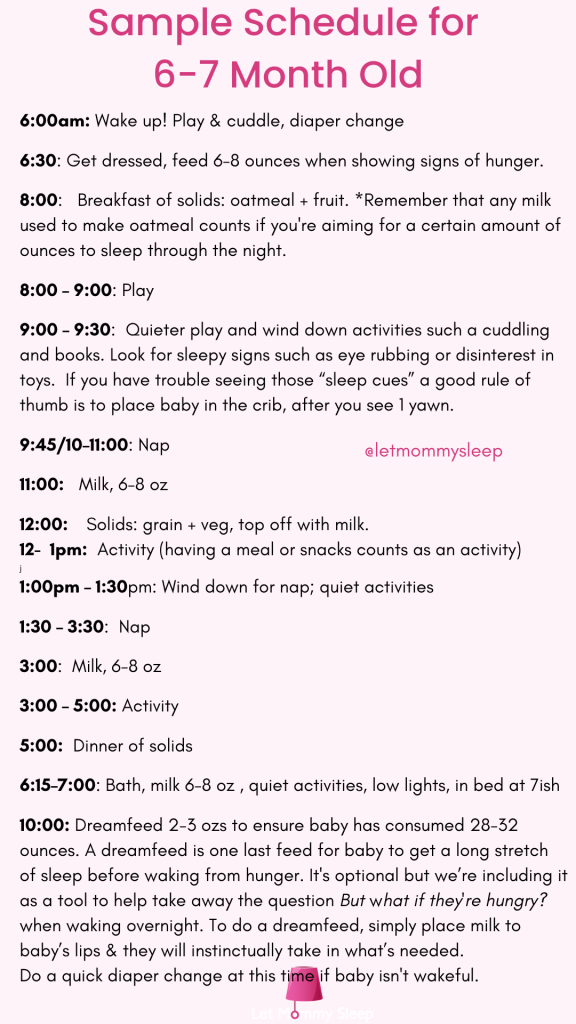
Sample Schedule for a 6 to 7 Month Old
6:00am: wake up, play and cuddle
6:30: diaper change, get dressed, feed 6-8 ounces when baby is exhibiting signs of hunger; this can beright at wake up or after 1/2 hour or more.
8:00: breakfast of solids: oatmeal + fruit. Give as much as s/he wants. ***Remember that any milk used to make oatmeal counts toward daily ounces.
8:00 – 9:00: Play
9:00 – 9:30: quieter play and wind down activities such a cuddling and books. Look for sleepy signs such as eye rubbing or disinterest in toys. If you have trouble seeing those “sleep cues” a good rule of thumb is to place baby in the crib, after you see 1 yawn.
9:45/10–11:00: Nap
11:00 milk, 6-8 oz
12:00 solids: grain + veg, ***top off with milk
12:00 – 1:00 activity (having a meal or snacks counts as an activity)
1:00pm – 1:30pm: wind down for nap
1:30 – 3:30: nap
3:00: milk, 6-8 oz
3:00 – 5:00 activity
5:00 dinner of solids
6:15 – 7:00 bath, milk 6-8 oz , quiet activities, low lights and in bed at 7ish
10:00p dreamfeed several ounces if needed to ensure she’s reached about 28 ounces. A dreamfeed is one last feed for baby. This may not be needed at 6/7 months but we’re including it as another tool to help take away the question “What if s/he’s hungry?” when baby wakes overnight. To do a dreamfeed, simply place breast/bottle to baby’s lips and s/he will instinctually take in what’s needed. Do a quick diaper change at this time as well.
Things to remember:
– THIS IS JUST AN EXAMPLE. It is FINE if your schedule differs and we should never force baby into a schedule that doesn’t work. The goal here is to give baby a start and end to the day with efficient feeds during daytime hours to set the stage for long sleep overnight.
– We are just using 6:00am as a starting point. If baby wakes earlier or later, simply adjust the schedule accordingly.
Sources:
Natasha Pressley, RN and the University of Maryland Pediatric Sleep Center
“Secrets of The Baby Whisperer”, Melinda Blau and Tracy Hogg
The hundreds of babies our nurses and NCP’s have cared for from 2010 to the present.