Blog


The role of the Registered Nurse or Newborn Care Provider is to feed, soothe, bathe, change & provide all other gentle care to baby through the night.

Home » Page 28

Repaying Sleep Debt as a New Parent

updated, Aug 1, 2023 – Sleep debt is defined as the difference between the amount of sleep you should be getting and the amount you actually get. Parents of newborns realize that sleep deprivation is something that comes with the territory but every time you miss out on sleep, you add to the debt. Over time this debt builds up and can lead to both mental and physical health issues.  This blog, Repaying Sleep Debt as a New Parent tells how you can get back your health and wellness.
Repaying Sleep Debt as a New Parent

Sleep Debt- The Facts

It’s important to note that short term loss of sleep is sometimes part of life. We all go through times where we don’t get a solid night’s sleep, such as during the newborn phase and it’s important to catch up on sleep when we can. However, long term sleep deprivation isn’t something humans easily bounce back from. Cognitive and metabolic function deteriorates and sometimes these functions don’t come back to our baseline level.

Repaying Sleep Debt as a New Parent

Research shows that a combination of naps and overnight recovery sleep can be effective in counteracting some negative effects of sleep deprivation. However, one or two nights of substantial sleep aren’t enough to fully pay off a long-term sleep debt. What does this mean for parents of single babies and twins?

A 2010 study conducted by acclaimed British sleep scientist Iftikhar Mirza found that during a child’s first 2 years of life, new parents miss out on an astonishing total of 6 months worth of sleep! Sleep deprivation can lead to poor eating habits, mood swings, arguments, adversely affect your performance at work and can make getting behind the wheel very dangerous

How to Minimize Your Sleep Debt

While there are no perfect foolproof solutions, here are some practical ways for new parents to minimize their sleep debt:

  1. Switch nighttime duties with a partner or caregiver. If possible, alternate nights or times of night between one partner sleeping and the other is “on call.” If nursing, mom can breastfeed and partner can do the diaper changes and soothing. Other options are for Mom to pump during the day and having partner give baby a bottle or supplement with formula overnight. Work with your lactation consultant or pediatrician to figure out what is best for you.
  2. Get regular exercise. Exercise releases endorphins, increases healthy energy levels and lowers the risk of mood swings. Even if you are too tired, gentle exercise during the day, such as walking or yoga, can increase sleep.
  3. Do not consume too much food or alcohol before bedtime. Eating or drinking too much in the evening can over stimulate the digestive system and interfere with natural sleep rhythms, particularly reducing reduces rapid eye movement (REM) sleep.
  4. Ask for help! It is important to rely on family members, friends, babysitters, night nurses, etc. for help. There is nothing wrong with having another person tend to the baby or household tasks while you catch up on much needed rest if it will make you a better, more attentive parent.

newborn sleeping in crib, postpartum mom in bed

Being a new parent is tiring, especially for those in the postpartum phase recovering from childbirth. IT IS OKAY to have dirty dishes and unfolded laundry. New parents, especially breastfeeding mothers, need their energy and while you may feel like you are missing out on “getting things done,” you will actually be catching up on something very important…repaying your sleep debt.

How to Offer a Bottle to A Breastfed Baby

I will be returning back to work soon, and my breastfed baby refuses to take a bottle of breastmilk or formula.  Help!” Amy Black, IBCLC, answers this common question with practical strategies for introducing a bottle to a breastfed baby.

How to Offer a Bottle to A Breastfed Baby
photo by Rainier Ridao on Unsplash

How to Offer a Bottle to a Breastfed Baby

Many parents worry when their breastfed baby refuses a bottle, especially before returning to work or leaving the baby with another caregiver. With the right timing, technique and patience, your baby can make the transition.

Here are a few basics:

  1. Babies are smart and know where milk comes from. If mom is nearby, your baby may refuse the bottle. Sometimes it helps if another caregiver tries while mom leaves the room—or even the house.
  2. Experts recommend waiting until breastfeeding is well established, usually after 4 weeks, before introducing a bottle. This protects your milk supply and prevents nipple confusion.
  3. La Leche League suggests pumping once a day after a feeding when your breasts still feel slightly full. Remember, you’re pumping “leftovers” so don’t expect a large amount.

Why Won’t My Breastfed Baby Take a Bottle?

Refusal is often less about the bottle itself and more about comfort and habit. Babies are used to breastfeeding, the warmth of mom’s body, and the familiar nursing position. A bottle can feel foreign at first. Refusal may also happen if the baby is too hungry, overtired, or if the flow of the nipple feels unnatural.

How Do I Get My Baby to Take a Bottle When I Go Back to Work?

Try these strategies to ease the transition:

  • Offer the bottle when baby is calm, not starving or fussy. A slightly sleepy baby is often more willing to try.
  • Have someone other than mom do the feeding, ideally in a different room than the usual nursing spot.
  • Encourage baby to open wide by gently touching their lips with the nipple. Let them draw it in instead of pushing it in.
  • Hold baby upright and keep the bottle horizontal, which mimics breastfeeding and slows the flow.
  • Stop when baby shows signs of being done—pushing out the nipple, turning their head, or falling asleep. Don’t force the last drops.
  • Warm both the milk and the nipple so the experience feels familiar.

What Is Paced Bottle Feeding and Why Is It Best for Breastfed Babies?

If your breastfed baby struggles with the bottle, paced bottle feeding is the most recommended method. This technique mimics breastfeeding by slowing the flow of milk and letting the baby control the pace.

Here’s how it works:

  • Baby is held upright during the feed, similar to nursing.
  • The bottle is kept at a horizontal angle so milk only fills the nipple halfway.
  • The slower flow allows for natural breaks, prevents overeating, and reduces gas or reflux.

By avoiding overfeeding, paced feeding helps mom maintain her milk supply while pumping at work. It’s also less overwhelming for the baby and more like breastfeeding.

What If My Baby Still Refuses the Bottle

Every baby is different. Some adjust quickly, while others need repeated practice. If your baby resists, try different bottle nipples with slower or faster flows, experiment with temperatures, or let the baby play with the bottle outside of feeding times to get familiar with it.

Consistency is key. Keep practicing once a day, and stay patient. Over time, most babies learn to take the bottle when needed.

Quick Takeaways for Parents

  • Introduce a bottle only after breastfeeding is established (about 4 weeks).
  • Offer the bottle when baby is calm and not too hungry.
  • Let someone other than mom feed, ideally in a new location.
  • Use paced bottle feeding to mimic breastfeeding and protect milk supply.
  • Be patient—bottle feeding is a learned skill for babies.

Need to know what bottles work best for you and your baby? Check out the Essential Guide to Baby Bottles.

Guide to Hiring the Perfect Babysitter


Updated July 26, 2021 If you’ve never hired a babysitter or nanny, it can be hard to know what makes a great candidate, especially if you have a newborn or infant. Here’s our guide to hiring the perfect babysitter!

Guide to Hiring the Perfect Babysitter – Basic Questions to Ask Potential Sitters:

  • Have you had experience babysitting an infant before?
  • How old are the children you have worked with before?
  • If you’re breastfeeding, ask your sitter if they have experience in preparing breastmilk. If you feed by formula, make sure they know how to prepare/heat the formula.
  • Are you familiar with how to put an infant to bed?
  • Do you know First Aid? Are you CPR certified?
  • What types of activities do you do with children?
  • How do you help a fussy baby?
  • Do you have your COVID and flu vaccines or other immunizations recommended by my pediatrician?

Trust Your Gut

When you meet someone for the first time, get a read on them. Do they seem interested in your child? Do they answer your questions with enthusiasm and confidence? Are they distracted by their phone? Parental instinct is very strong and your own instincts are almost always correct.

Check References

We’re SHOCKED at the number of times people don’t check references! Ask for at least two references of non-family members that you can contact by phone; a references’ tone of voice can be as telling as the actual answers. Don’t feel uncomfortable asking questions; you are your child’s advocate and protector.

Are Credentials Important to You?

Many sitters take the Red Cross Babysitter Certification. Is this a requirement for you? How about CPR or First Aide Certification? If these are qualifications you’d like your sitter to have, ask those questions in the interview.

Guide to Hiring the Perfect Babysitter – Now What?

Guide to Hiring the Perfect Babysitter
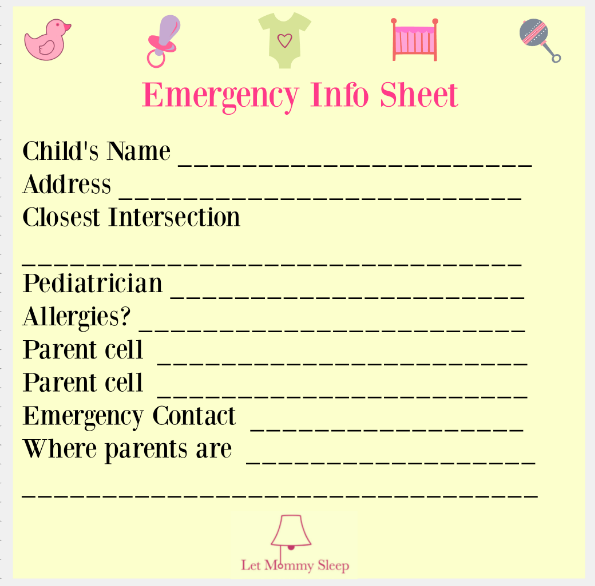
  • Once you hire the sitter, make sure that you have all of your emergency info in an easily accessible place. You can copy our Emergency Info Sheet here if you need to!
  • If you have a landline, show the sitter where it is.
  • If you don’t use a landline, make sure you have a both iPhone and Android chargers in the house. The babysitter’s phone should be charged at all times.
  • It’s perfectly fine to use a nanny cam while you’re out and it’s your legal right to have a camera anywhere except the bathroom or other places where there is an expectation of privacy (like the bathroom).  Please be considerate to your babysitter and let them know you’re recording. You never know- if baby has an accident or spits up, your sitter might need to do a quick clothing change! 

\

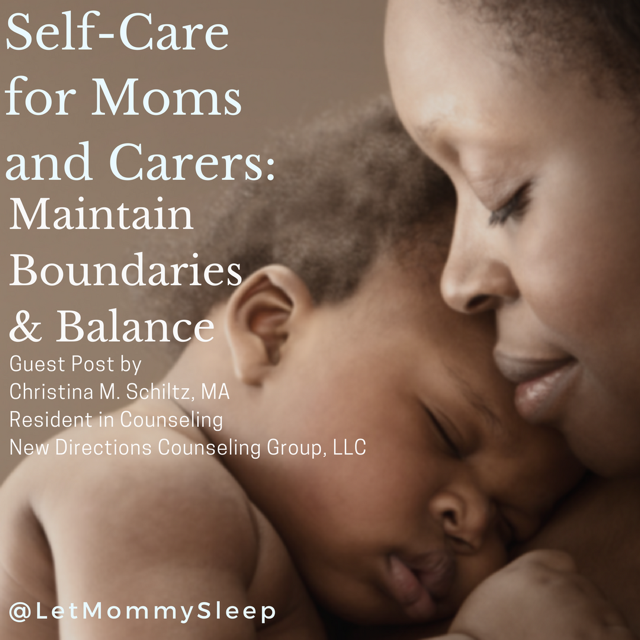
Self Care Plan for Moms & Caregivers

As a counselor to new mothers and caregivers, Christina M. Schultz, MA has seen many women experience, “caregiver burnout” or complete fatigue, exhaustion, depression, resentment, loss of identity, and sense of low self-worth.  To help those who may be at risk of burnout, Schultz has created this Self Care Plan for Moms & Caregivers.

Self Care Plan for Moms & Caregivers

I often hear women who devalue their self-worth and chose to take care of others as their first and foremost priority.  I work to encourage women who are mothers and caregivers to place self-care as their top priority to prevent burnout, to provide resilience and empowerment, and because it helps women to maintain appropriate boundaries in the spousal, parenting, and/or caregiving relationships and roles. 

For any women attempting to balance role demands of parenting, work, caregiving, marriage, and relationships with family-of-origin, self-care and boundaries are your key to balanced living.  A whole self-care plan needs to integrate the four aspects of you – which includes physical, emotional, social, and spiritual health. Below are a few key suggestions for any self-care plan.

Self Care Plan for Moms & Caregivers

  1. Build a Support System or Network Outside of Your Spouse, Children, and Parents (Social and Emotional Needs). This is important in order for you to not over rely on the emotional and social needs from your immediate family, and help you to not be over-preoccupied on the needs of your family.  I encourage you to find or create your own peer support group of moms, caregivers, and so forth. 
  2. Ask for and Accept Help. Clarify and Strengthen Relationship and Responsibility Boundaries and Division of Labor of the Household, Parenting, and Financial Admin Duties (Emotional and Physical Needs). This is important for you to reduce your role demands and overload if you have the tendency to do too much.  This is also your chance to assertively communicate your needs and desires with your spouse and negotiate a win-win for you both.  Your spouse should want to find a middleground, and if not, you need to consider how you may be selling your needs short.  If you lack the time and have the financial resources, you and your spouse have the option to hire more help with cleaning, childcare, and financial planning and investing duties.
  3. Assertive Communication of Needs.  Learn how to assertively and appropriately ask for help and the love you need with “I” statements (Social and Emotional Needs).  If you ask for help clearly, assertively, and appropriately, you will be received with respect and people will tend to meet your needs. It is suggested to encourage children as young as toddler-age to help with chores, and to increase their responsibility over time.  It is also suggested to communicate your needs for emotional and sexual intimacy from your spouse, and specific help you need from your spouse since your partner is not a mind-reader.  “I” language assertively communicates your feelings with a specific need.  As one example:  “I feel upset that I make dinner every night each week.  I would appreciate it if you cooked Mondays and Fridays or if we ordered take out those nights.  What do you think about this?”
  4. Make time for yourself to exercise, sleep, and eat several balanced meals each day, and attend your annual health appointments (Physical Needs).
  5. Learn how to say no and prioritize (Emotional and Physical Needs).  If you are someone who tends to err on “doing too much” than you have to learn how to say no and dig further on what you may be avoiding with your business.  Sometimes business has a secondary gain, such as the avoidance of people rejecting our requests for help and/or avoidance of feeling lonely. 
  6. Pray, meditate, and/or read something grounding once a day for a few minutes (Spiritual Needs).  Research has established that people who engage in positive religious and spiritual coping, whether tied to an organized religion or not, tend to be mentally healthier and approach distressing life events with increased resilience.  Whether you find calm and strength from attending Church weekly, praying each day, engaging in mindfulness meditation, or reading a powerful deep quote each day, it is an important way to keep yourself in-touch with your deeper values and meaning, beyond the trivialities of life.
  7. Write down or verbalize three things you are grateful for each day to build more appreciation in your life. (Emotional and Spiritual Needs).  This positive psychology exercise is linked to increased feelings of meaning and satisfaction in the here-and-now, and reduced depression.

Questions to Ask When Hiring a Night Nanny or Postpartum Doula

Considering extra support when your newborn or twins arrive? Before the interview, it might be helpful to think about what aspects of baby care will be most helpful to you. This guide, Questions to Ask When Hiring a Night Nanny or Postpartum Doula is a starting point for families considering night doula care of their newborns, infants or twins.

Baby Nurse Joy at a certified newborn care training
Joy, LPN has lots of experience with twins and multiples!

Key Things to Consider Before Hiring Newborn Help

  • Daytime vs. Overnight Care
    Do you need someone who helps during the day with light household tasks and older siblings, or is overnight sleep your top priority? Read What’s a Night Nanny? Roles, Benefits, Costs and How They Help Families if you’d like to learn exactly what happens when you hire a night doula.
  • Support for Your Feeding Choices
    Do you want help with breastfeeding, pumping, or bottle feeding? Look for someone trained and nonjudgmental.
  • Experience and Certifications
    Is it important to you that your caregiver has formal training, years of hands-on experience, or both?
  • Sleep Philosophy
    Do you want someone to support sleep training, baby-led schedules, or a flexible approach?
  • Vaccination Status – In healthcare roles, you can ask a caregiver their vaccination status in order to protect your newborn who is too young to be vaccinated themselves.

Questions to Ask When Hiring a Night Nanny or Postpartum Doula

1. Would daytime or overnight care be more helpful for my family?

A daytime nanny can help with older children and household tasks, while an overnight nanny allows parents to maximize rest. Consider your family’s needs, work schedules, and recovery time.

Real life scenario: if you have a short maternity leave and need to return to work quickly, having uninterrupted overnight sleep may be most valuable for recovery. If you have older children, a daytime nanny might give you the space for one-on-one bonding time with each child while ensuring the newborn’s needs are met

2. Do I want support with breastfeeding, pumping or bottle feeding?

Postpartum doulas can offer lactation guidance, help with pumping routines and ensure bottle feeding is safe and consistent. Feeding choices often evolve, so it’s best to work with someone flexible and nonjudgemental.

Real life scenario: A mom recovering from a C-section desperately wants to breastfeed but is in pain and exhausted. Her night doula suggests 1 formula feed overnight, giving the mother a long stretch of uninterrupted sleep and a chance to recover. The next day they assessed and followed the same plan again. Over time the mother recovered without feeling pressured or like she was “failing.”

3. What kind of newborn and postpartum care experience do the doulas have?

Newborn and infant care (0-12 months) requires specialized knowledge: safe sleep, swaddling, soothing techniques and recognizing infant feeding and sleep cues. An academic training program that uses evidence-based practice can ensrue hte caregiver is up to date on safety recommendation. Also ask about hands-on experience, especially with twins or multiples. Remember: only licensed nurses (RN, LPN, LVN, CNM) can legally use the title “nurse” or “baby nurse.” If you’d like to learn more about safe sleep before baby arrives, read 10 Steps to Safe Sleep for Baby.

Real life scenario: There are many parents of twins who go on to work overnight helping other parents with newborn twins. While this caregiver may not have had formal training, their life experience might be the perfect fit for a family expecting twins.

4. How should my newborn caregiver approach infant sleep? Do I want someone to help my baby sleep through the night, or will I be more of a ‘go with the flow’ type? 

Some families aim for babies to sleep through the night quickly, while others prefer a baby-led, flexible routine. There’s no right or wrong answer, but your caregiver should align with your philosophy, whether that’s sleep training, attachment parenting or getting baby on a schedule

Real life scenario: Sleeping through the night is often seen as the “finish line” in infant care, especially when newborn twins arrive because caring for 2 newborns is so physically demanding. A night doula who understands and supplements your sleep philosophy means consistency of care. It will be helpful to think about how you feel about sleep training, attachment parenting or getting baby on a schedule before baby arrives.

Questions to Ask a Night Nanny for Your Newborn Twins

Families expecting twins often consider hiring help, especially if they have older children as well. Think about what benefits your family the most- overnight sleep help or daytime support with feedings, laundry and older kids. You might want overnight newborn care while you recover and then a transition to daytime nanny care.

Feeding Support:
Ask: Can your nanny support you with tandem breastfeeding, bottle-feeding or pumping schedules? Choose someone flexible and experienced with twin feeding routines.

Experience with Twins:
Ask: How many sets of twins or triplets has the caregiver supported? Ask about specific training in safe sleep, soothing and tracking feeds for multiples. Remember, even if they haven’t specifically cared for twins, they may have cared for babies close in age and this can be helpful experience too.

Sleep Philosophy:
Does the night doula promote baby-led or scheduled sleep? Does this align with your approach? Twins often thrive on coordinated routines, so confirm that your philosophies work together.

Safety & Vaccination:
Since newborns are too young for vaccines, ask if your nanny is current on Tdap, Flu and MMR, and what their hygiene practices are.

Quick Takeaway: The best night nanny for twins blends hands-on experience with flexibility. Look for a caregiver who supports your feeding choices, prioritizes safety and helps both babies (and parents) get the rest they need.

If getting baby on a schedule and sleeping through the night is important to you, read the Ultimate Guide to Baby Sleep Training.

Questions to Ask When Hiring a Night Nanny or Postpartum Doula – Final Thoughts

The titles may vary from postpartum doula, night nanny to newborn care provider, but the goal is the same: reliable, compassionate support during the postpartum phase. Choose someone who respects your parenting choices, communicates clearly and helps your whole family thrive.

Questions to Ask When Hiring a Night Nanny or Postpartum Doula