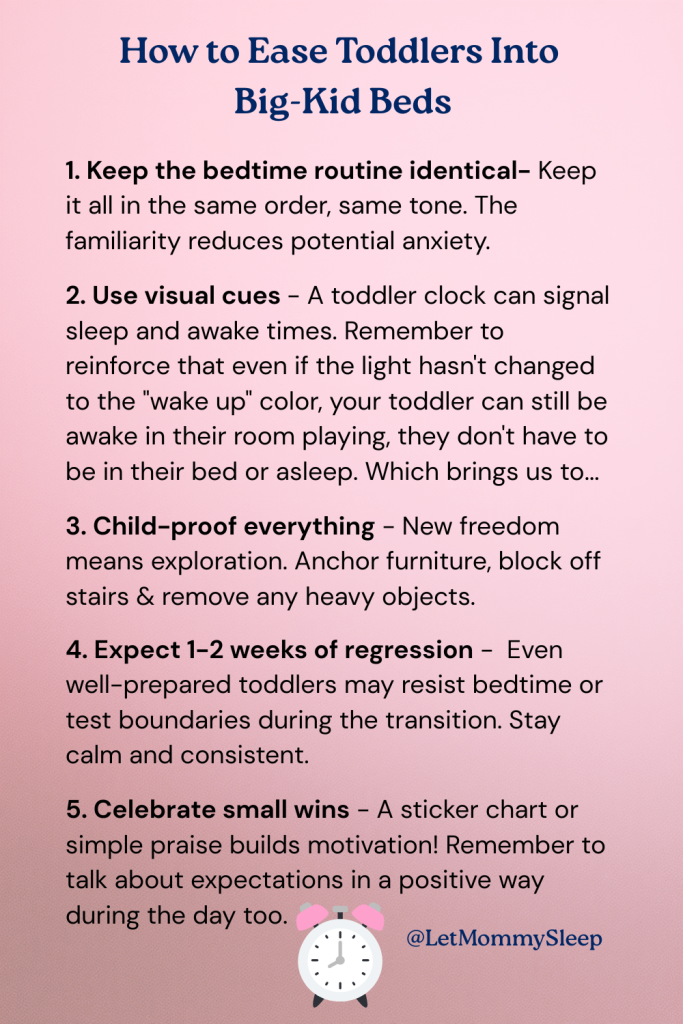
How to Ease Toddlers Into Big-Kid Beds
Even with all the sleep advice out there, it can be hard to know how to transition your little one from the crib into their big-kid bed. Looking out for signs of readiness, safety and the set-up of your home are all considerations when making the switch. This blog, How to Ease Toddlers Into Big-Kid Beds will help you identify when and how to make this milestone a healthy and happy one.

Key Takeaways of How to Ease Toddlers Into Big-Kid Beds
- There are clear signs, such as climbing out of the crib, that your older baby or toddler is ready to leave the crib.
- The “stay in bed” instruction can be too abstract for children under age 3 so there’s no need to rush.
- When they’re ready follow the 5 Steps of Sleep for a smooth transition.
- Sleep training and big bed transition can happen at the same time.
- Every child is different and there are many options for how to ease toddlers into big-kid beds
When is the Right Time?
While creating a “big kid” room can be exciting, research like this study in the NIH consistently shows that waiting until close to age 3 to transition to a toddler bed leads to better sleep outcomes. That’s because in the late 2’s and early 3’s, most toddlers are physically outgrowing the crib, while at the same time, are developmentally able to understand the expectation of staying in their own bed for the night. Therefore, timing the switch around your child’s readiness means fewer bedtime battles, fewer night wakings and longer stretches of consolidated sleep.
There are a few clear signs that your older baby or toddler is ready to leave the crib:
- They’re climbing out of the crib consistently: This simply becomes a safety issue. Before transitioning, try lowering the mattress, using a sleep sack, or placing the crib in a corner to prevent climbing.
- They’re asking for a big kid bed: Some kids express this readiness themselves, usually after age 3.
- Your toddler is able to comprehend instructions such as “stay here” or “stay in your room while the light is red” if you’re using visual cues.
- And of course, if baby is too big to fit in the crib, it’s time to move them to a more appropriate space.
If none of these signs are present, there’s no need to rush the transition. Most 2-year-olds are still learning impulse control and rule-following, so the “stay in bed” instruction can be too abstract for children under age 3. On that note, if you’re expecting a new baby soon, don’t add stress by forcing an early transition just to free up the crib. Consider using an infant safe sleep space like a bassinet or play yard for the newborn instead.
On the other hand, even if your child is exhibiting all the signs of readiness, it’s important to remember that the actual transition time may take several nights or even a few weeks. Your child may need to practice staying in the bed or getting comfortable and that is perfectly fine!
How to Ease Toddlers Into Big-Kid Beds: 5 Steps of Sleep
If your toddler is ready, here are 5 steps of sleep to ensure a smooth. peaceful transition:
- Make the room safe: Anchor furniture, remove hazards, and think from your toddler’s perspective.
- Involve your child: Let them pick sheets, try out a single size mattress or choose a stuffed animal to bring to bed.
- Set expectations: Practice staying in bed and use visual cues like OK-to-wake clocks.
- Stick to routines: Keep the bedtime routine familiar and calm.
- Have a plan for boundary-testing: What will you do if they get out of bed? If you prefer them to stay in their own bed for the entire night, you can gently but consistently return them to bed if they get out.
- Talk about the expectation before it happens and remind your toddler that this is an exciting milestone; You’re such a big kid, you get to have your own bed now!
Should You Combine Sleep-Training and the Crib-to-Bed Transition?
For toddlers who have never slept through the night without waking, some parents choose to sleep train at the same time as the crib-to-bed transition. Here’s what to know if you’re considering both at the same time:
Step 1: Understand What’s Changing
Both sleep-training and moving from a crib to a bed represent major developmental shifts. Understand that sleep-training teaches self-soothing and sleep independence while a crib-to-bed transition introduces new freedom and less physical containment. Doing both at once means your toddler must learn two new skills simultaneously.
Step 2: Ask Yourself These 5 Questions
If you can answer “yes” to most of these, sleep training while transitioning to the big bed will likely work for your family (some of these are the same from above):
- Has your toddler started climbing out of the crib?
- Are there no other major changes happening (new sibling, potty training, moving homes)?
- Do you have 2–3 weeks to focus on a consistent bedtime and naptime routine?
- Are you confident your toddler can follow simple bedtime boundaries (“stay in bed until the light turns green,” etc.)?
- Are you emotionally ready to be consistent even if nights and naps are rough at first?
If you answered “no” to several, it’s often smoother to separate the two; either sleep train first in the crib or move to a bed and tackle sleeping independently once the bed is firmly established.
Best Practices If You Combine Both
1. Keep the bedtime routine identical – Keep it all in the same order, same tone. The familiarity reduces any anxiety and as the American Academy of Sleep Medicine has shown, “the positive impact on sleep increases with the consistency of the nightly routine.”
2. Use visual cues – A toddler clock or light can signal when it’s okay to get up. Remember to reinforce that even if the light hasn’t changed to the “wake up” color, your toddler can still be awake in their room playing and or reading, they don’t have to be in their bed or asleep. Which brings us to…
3. Child-proof everything – New freedom means exploration. Anchor furniture, block off stairs and remove any heavy objects that might fall. A tip our night doulas like to share is to consider floating shelves instead standing bookshelves that can become a toddler’s ladder.
4. Expect a 1–2 week regression – Even well-prepared toddlers may resist bedtime or test boundaries during the transition. Our job as parents is to stay calm and consistent.
5. Celebrate small wins – A sticker chart or simple praise (“You stayed in bed all night, I’m so proud!”) builds motivation and ownership. Remember to talk about nighttime expectations in a positive way during the day as well.
When to Separate Sleep Training and Big Bed Transition
If your toddler: still wakes multiple times a night, has high anxiety about the new bed or is undergoing another big life change, then focus first on sleep-training in the crib. An example of a life change might include: starting daycare, a new sibling, a long vacation or a time change is coming up.
Once sleep is consistent (2–3 weeks), introduce the new bed. Communicating the expectation is key and you can find more guidance from our team in Sleep Coach Your Toddler: A Parents Guide
There are Plenty of Options
There’s no rush to transition into the big kid bed. You can also skip a toddler bed altogether and move straight to a twin bed. A larger bed can grow with your child for years to come, making it a worthwhile investment and one less transition down the line. To make the twin bed extra safe, you can include a guardrail or keep the mattress low to the floor without a boxspring.
As you move through this milestone, remember that every child is unique, and there is no one ‘right’ timeline for making the switch from a crib to a bed. And while there are many night nannies, doulas and toddler experts out there, you’re the expert in your child. What matters most is creating an environment that is safe and inviting for your little one. Whether the transition happens in 1 night or over the course of a week or 2, the change from crib-to-bed isn’t just about a bed. It’s about nurturing your child’s growing independence and setting the stage for restful, happy sleep.