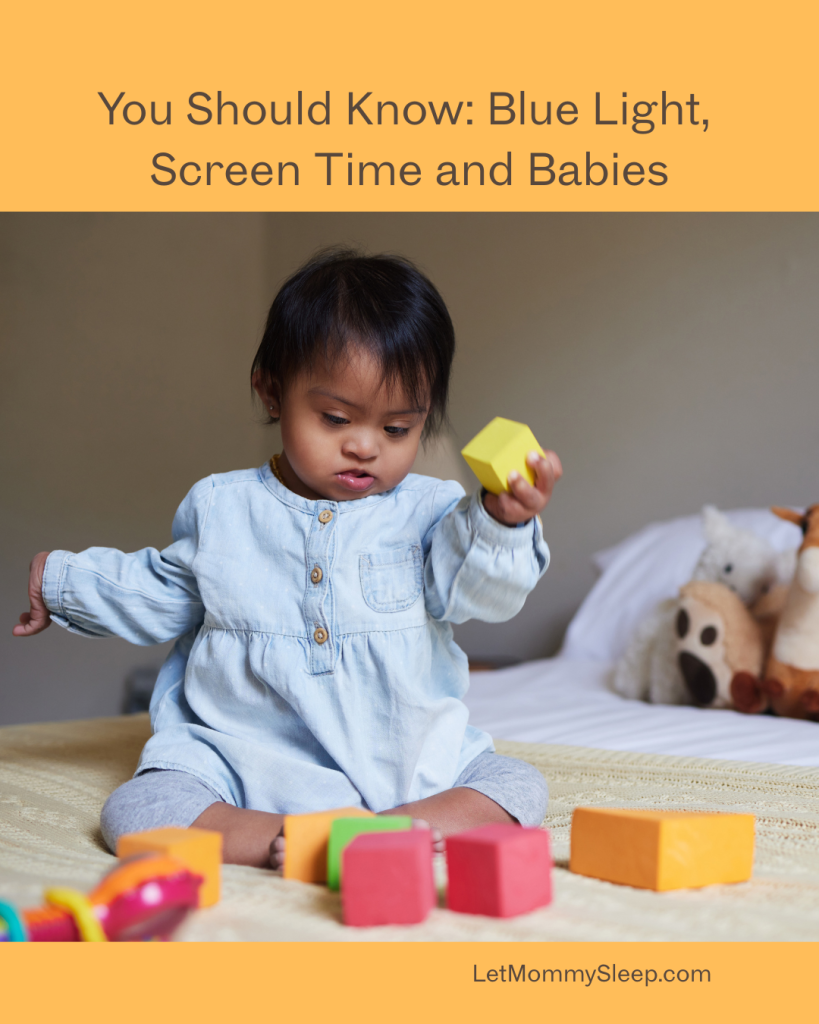
You Should Know: Blue Light, Screen Time and Babies
Updated November 11, 2025 – This article explains why the AAP and WHO recommend no screen time for babies under age 2, how blue light affects sleep and vision, and practical alternatives parents can use.
According to the American Academy of Pediatrics (AAP) and the World Health Organization (WHO), children age 2 and younger should avoid screen time except for video chatting. The major reasons are because early exposure is associated with disrupted sleep, delayed speech and behavioral issues. This article, You Should Know: Blue Light, Screen Time and Babies goes into more detail about each.
You Should Know: Blue Light, Screen Time and Babies- Why it Matters
Screen use effects all of us really, but newborns, infants and toddlers and particularly vulnerable to the negative effects of screen time. Their systems are still immature so screens and blue light may take a greater toll.
- Can early screen time cause aggression or behavioral changes? – Early screen use is associated with more aggressive behaviors. Again this doesn’t mean screens cause aggression, just that the two are associated. This may be because babies exposed to overstimulating visual input have less opportunity to practice emotional regulation through real-world play.
- Possible Delayed Speech and Sensory Processing – When computers or TV’s are on adults say fewer words, giving infants less chance to learn speech. Add in the child’s media use and even less communication happens.
- Developing Circadian Rhythm Disruption – Blue light exposure in the evening leads to confusion between day and night. This is true for adults too.
- Melatonin Suppression – Prolonged exposure to blue light after the sun goes down may interfere with the natural increase in melatonin levels, making it harder for infants and toddlers to fall asleep.
- Fatigue and Increased Potential for Eye Strain – Screens may potentially be harmful to the human retina as it puts increased stress on the receptors in the eye. Research on this is still ongoing but we do know that when we watch screens, we blink less which causes strain. (NIH)
How Much Screen Time Is Too Much for Infants?
While your child may be just fine, it’s important to know that all major pediatric health organizations agree that newborns and babies age 0-2 years old, should not be exposed to screens, unless they are videochatting with family. Behavioral issues, communication delays and atypical sensory processing are connected to early screen use. This is not to say screens cause these issues, just that they are associated. Current research shows associations between early screen use and developmental concerns, but not direct causation. This distinction is important because it reflects the complexity of infant development and helps parents make informed, realistic choices.
I hear a lot of parents say, ‘But my baby likes it!’ Infants may stare at the bright colors and motion on a screen, but their brains are incapable of making sense or meaning out of all those bizarre pictures. -David L. Hill, MD, FAAP, pediatrician and spokesperson for the American Academy of Pediatrics (AAP).
Babies learn to speak by watching us. So in addition to confusion at what they’re seeing on screen, the amount of words they’re hearing from us drops as well (AAP).
It can be so hard to keep your infant and toddler occupied though! Especially when we have other kids to care for, are working from home and have little to no family support. While it sounds hard, the easiest way to limit screens may be to avoid them altogether; taking screens off the table means we have to find other options.
“The infant brain thrives on enriching interactions with the environment, and excessive infant screen time can reduce opportunities for real-world interactions that are important for brain development,” says Dr. Carol Wilkinson, developmental behavioral pediatrician at Boston Children’s Hospital. It’s important to note that Dr. Wilkinson reminds us that parents should be supported with tips and tricks for non-screen activities.
Why Does Blue Light Affect Sleep?
Blue light is present in sunlight and is a natural component of the light spectrum. If blue light is already present in just about everything we see, why should we worry about limiting exposure in infants? The answer is because artificial exposure to blue light confuses infants’ immature systems.
Developing Circadian Rhythm Disruption – Blue light plays a significant role in regulating the body’s internal clock. We know this as the circadian rhythm. Like adults, newborns and infants rely on a stable circadian rhythm to promote healthy sleep-wake cycles every 24 hours, but babies’ little systems can easily be confused. Any overnight nanny will tell you it’s difficult to flip your sleep schedule because of the strong pull of our natural circadian rhythm!
Melatonin Suppression – Melatonin is the hormone that promotes sleep. Our bodies begin to produce it as a reaction to darkness at night. Because they are still developing, a child’s melatonin production is sensitive to blue light exposure and blue light, in particular, has been shown to suppress melatonin more effectively than other wavelengths. Prolonged exposure to blue light in the evening may interfere with the natural increase in melatonin levels. We see this as adults as well!
Poor Sleep Quality and Sleep Disruption – Melatonin suppresion delays the onset of sleep. This delay has a second effect of inhibiting the increase in sleepiness during night. In other words, babies have less restorative sleep.
Fatigue and Increased Potential for Retinal Damage – Babies’ eyes are still developing. Prolonged exposure to blue light from screens at a young age could potentially contribute to eye strain and discomfort. More research is needed to fully understand the long-term effects of screen exposure on infants’ eye health but we do know that screen use can cause digital eye strain and fatigue in adults.(American Academy of Opthomology)
What Can Parents Do Instead of Screen Time?
Infants and toddlers have sensitive developing minds and bodies that are easily influenced, and as children get older monitoring the actual content becomes more important. The good news about children age 2 and under is that they are natural scientists and interested in the world around them! Here are some ideas of what you can do instead of screens:
- Put a blanket down outside and lay down with baby on your backs to watch the leaves fall, watch the sun make shadows or look for airplanes. If you’re outside too you can place baby safely in a play yard.
- Give your toddler building toys like Magnatiles or soft blocks allow them to engage in active play.
- Invest in plastic balls to make a mini ball pit in baby’s playyard
- Fill a tissue box with different colored fabrics or handkerchiefs; let baby pull them out!
- Give baby a wooden spoon and plastic bowls so they can “cook” while you’re cooking.
For more ideas, visit 50 Things To Do With Babies During the First Year.
FAQs
- How much screen time is safe for infants?
None, except brief video chats, according to the AAP and WHO. - Can blue light blocking glasses help babies?
There’s no proven benefit for infants. Limiting screens before bedtime works better. - What’s the best alternative to screen time for babies?
Real-world sensory play like using simple blocks, being outside in nature or being safely nearby watching while you narrate an activity. - Does blue light affect baby sleep?
Yes. It suppresses melatonin and confuses the body’s internal clock, making it harder to fall asleep. - What if caregivers use screens when helping?
Be kind but clear, explain that avoiding screens supports baby’s development and helps them sleep.
Products are available to minimize blue light such as glasses and blue light blocking screens, but data from the NIH does not show that these products are helpful or effective. Most healthcare providers agree that the best way to minimize blue light’s effects is to stay away from screens at night or before sleep.
The bottom line: Screens themselves aren’t “evil,” but for babies under age two, every minute on a screen replaces time their brains could be using for human interaction and sensory play.

Categories
- Corporate Care & Partners
- COVID19 Archive
- En Espanol
- Expert Guides
- Hiring a Night Nanny
- Infant Safety
- Infant Sleep Hub
- Newborn Care
- Postpartum Health
- Twins & Multiples
- Work as a Night Doula
- zPost Archives