Baby Speech Milestones: A Guide from Newborn to 18 Months
Baby speech milestones follow a general pattern across the first 18 months. By 6 months most babies babble, and by 12 months most say mama and dada with intention. By 18 months, most young toddlers have 4-10 words and can point in order to communicate needs. Here is what to expect at each stage from birth to 18 months.
Updated April 2026 — milestone guidance reflects the 2022 CDC expanded framework.
Infant speech and communication development varies from child to child, and can also be influenced by family dynamics such as having older siblings or even being a twin. The American Academy of Pediatrics provides general guidelines parents can use to gauge their baby’s development and start conversations with their pediatrician if parents have concerns. The milestones below reflect behaviors that 75% or more of children demonstrate by a specific age, a standard established in the 2022 CDC/AAP update that replaced the older “may begin to” language with more actionable benchmarks.
These milestones apply to full-term babies. For twins, multiples, and premature babies, use adjusted age when tracking development.
Birth to 5 Months: Early Communication
- Cooing, vocal sighs and vowel sounds such as “ahhh”
- Laughter, crying and fussing as communication
- Reacting to loud sounds and familiar voices
- Quieting or smiling in response to being spoken to
What you can do with baby: Simply talk to and around your baby! Narrate diaper changes, describe what you see on walks or at the grocery store. You can sing too. These early conversations build the neural pathways for language even before baby can respond.
By 6 Months: Babbling Begins
- Babbling strings of consonant-vowel sounds (“bababa,” “mamama”)
- Taking turns making sounds with a caregiver
- Responding when their name is called
- Beginning to gesture or use actions to communicate
What you can do with baby: Practice what a Princeton study calls “serve and return,” meaning to respond to every babble as if it’s a real conversation. Taking turns where you talk, baby responds and you respond back, teaches the rhythm of communication.
By 12 Months: First Real Words
- Says “mama” and “dada” with meaning — referring to the actual person
- Vocabulary of 1-3 words beyond mama and dada
- Responds to simple requests like “come here” or “wave bye-bye”
- Points to objects or people to get attention or request something
- Imitates sounds and words heard in conversation
What you can do with baby: Label everything out loud. Point to the dog and say “dog.” Point to the cup and say “cup.” Repetition of labels is an effective way to help your child’s language skills in the short and long term.
By 17 Months: Vocabulary Expanding
- Vocabulary of 4-6 words used consistently and intentionally
- Understands and follows simple two-word directions
- Points to familiar objects when named
- Uses gestures alongside words to communicate
- May refer to themselves by name
What this looks like: Your 17 month old might say “more” while pointing at their plate, or “up” while reaching toward you. Single words combined with gestures count as intentional communication.
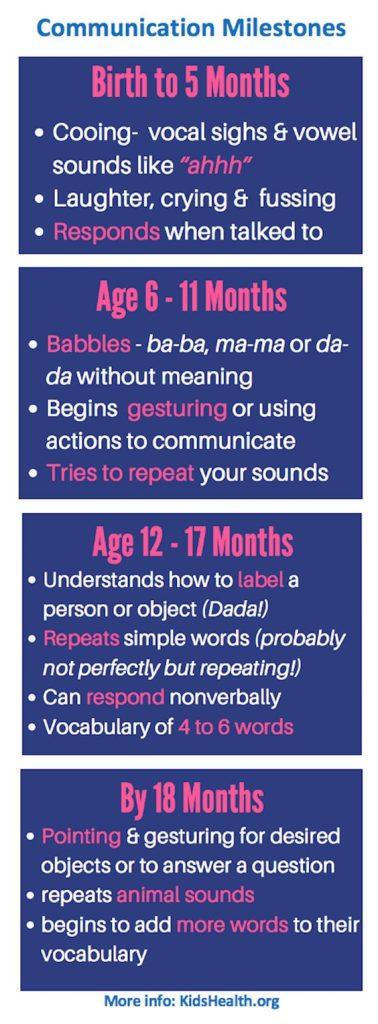
By 18 Months: Functional Communication
- Vocabulary of 10 or more words
- Adding new sounds; animal sounds and environmental sounds are typical
- Pointing and gesturing to answer simple yes/no questions like “Are you hungry?”
- Beginning to combine two words (“more milk,” “daddy go”)
- Using words more than gestures to communicate needs
When to talk to your pediatrician: If your 18 month old is not yet saying at least 10 words, is not pointing to things of interest, or has lost words they previously used, mention it at your next well-child visit. Early intervention for speech delays is most effective when started early.
A Note on Typical Variation
There is a wide range of typical development in babies and toddlers. Children with older siblings sometimes reach milestones slightly later because older kids “speak” for them, and that is normal. Children surrounded by older family members or peers often communicate earlier than expected. Twins and higher order multiples sometimes develop their own communication shorthand that supplements conventional speech.
What matters is the trajectory, steady progress over time, rather than hitting every milestone on an exact date.
Tracking Baby Speech Milestones
The CDC’s free Milestone Tracker app lets parents log developmental progress across all categories including communication, movement, and social skills. Our night nurse team finds it especially useful for parents of twins or babies born close in age where tracking multiple children’s development simultaneously can get overwhelming.
A Rested Parent Is a More Present Parent
The language-rich interactions that support speech development such as talking, reading, singing, responding to babbles require energy and presence. If you’d benefit from overnight newborn care, Let Mommy Sleep is here for you.