
Tummy Time Troubles Solved
updated, Nov 1, 2025 – Parents often hear about the importance of tummy time, yet overwhelmingly report their babies don’t want to do it! Tummy Time Troubles Solved has tips to help baby enjoy tummy time.
Why Does Your Newborn Need Tummy Time?
Newborns and infants often seem uncomfortable with being placed on their bellies when they’re awake, so why do we do it? Babies spend a LOT of time sleeping. And since it’s been proven that placing babies on their backs to sleep for the first year is one of the best ways to minimize the risk of SIDS, they also spend a LOT of time on their backs. Because of this, we need to give newborns and infants opportunities to exercise their next and shoulder muscles. Stronger muscles = healthier and safer babies. In addition to building neck and shoulder strength, tummy time supports motor development, prevents flat spots (positional plagiocephaly), and helps babies learn to push up, roll and eventually crawl. It’s not just exercise, it’s the foundation for all future movement skills.
So yes, tummy time is your baby’s workout and just like us, sometimes they don’t feel like working out! With slight but important adjustments though, infants can have comfortable, yet productive play and exercise.
Infant expert Terri Lee Weatherholtz, M.A, CCC-SLP, CDA says: “the time an infant is awake on the floor should consist of 50% back and 50% tummy time.” There’s no exact rules on when to begin tummy time sessions with your baby. Chances are it’s something you and your baby are doing together naturally anyway!
As a guideline however, you can start with 3-5 minute sessions 2-3 days after baby is born, and this is an accepted rule of thumb. As baby grows, tummy time can gradually increase to about 20–30 minutes a day by the time they’re 3 months old. Short, frequent sessions are better than long ones, think “floor time snacks,” not “floor time marathons.”
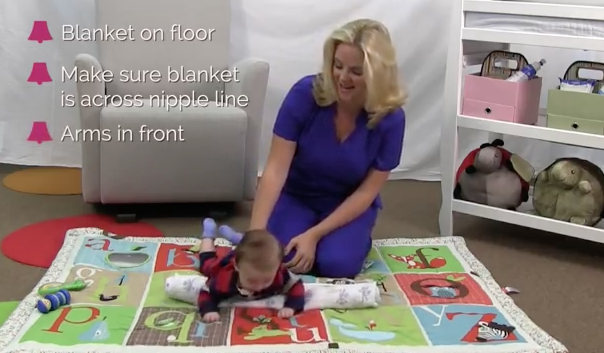
Tummy Time Troubles Solved – Steps for Success
- Roll a thin baby blanket (3–4 inches thick) to create a small chest lift.
- Place baby tummy-down with arms out front and chest resting at nipple level on the blanket.
- Keep the neck clear of the blanket so weight shifts backward off the tummy.
- Encourage movement: Use a firm but gentle stroke from the back of the head down to the bottom to activate the neck extensor muscles.
- Get face-to-face: Lie down on the floor to make eye contact. Smiling and talking help your baby lift their head and build social connection at the same time.
- Try chest-to-chest: Lying on your back with baby on your chest lets them look “up” at your face—a natural tummy time position for even the youngest infants.
Another way to help tummy time be a fun activity is to lay on your back with baby on your chest, so you’re face to face. With a gentle hold on baby for safety of course, baby will be motivated to look “up” at your face.
Night Nurse’s Reminder- Always supervise tummy time and use a flat, firm surface instead of a couch or bed to be sure baby is safely positioned.
It’s perfectly fine if tummy time only lasts 5 minutes or less some days. Eventually continuing the routine a few times a day for longer periods though, helps your baby equate “tummy time” with happy, social time. As always, if your baby consistently dislikes tummy time or shows limited movement or head control after a few weeks, talk to your pediatrician or a pediatric physical therapist.
For answers to more early care questions, visit our newborn care guide, Your First Week Home with Baby: Ultimate Q&A
{ “@context”: “https://schema.org”, “@graph”: [ { “@type”: “BreadcrumbList”, “itemListElement”: [ { “@type”: “ListItem”, “position”: 1, “name”: “Home”, “item”: “https://www.letmommysleep.com/” }, { “@type”: “ListItem”, “position”: 2, “name”: “Newborn Care”, “item”: “https://letmommysleep.com/blog/category/newborn-care/” }, { “@type”: “ListItem”, “position”: 3, “name”: “Tummy Time Troubles Solved”, “item”: “https://letmommysleep.com/blog/2017/05/02/tummy-time-troubles-solved” ] }, { “@type”: [“Article”, “MedicalWebPage”], “mainEntityOfPage”: { “@type”: “WebPage”, “@id”: “https://letmommysleep.com/blog/2017/05/02/tummy-time-troubles-solved/” }, “headline”: “Tummy Time Troubles Solved: How to Help Your Baby Enjoy Tummy Time”, “description”: “Expert tips from postpartum doulas, RNs, and infant specialists on safe and effective tummy time for newborns and infants, including step-by-step guidance and video demonstration.”, “author”: { “@type”: “Organization”, “name”: “Let Mommy Sleep”, “url”: “https://www.letmommysleep.com”, “logo”: “https://www.letmommysleep.com/logo.png”, “sameAs”: [ “https://www.linkedin.com/company/let-mommy-sleep-llc”, “https://www.pinterest.com/letmommysleep”, “https://www.facebook.com/letmommysleepnightnurses” ] }, “publisher”: { “@type”: “Organization”, “name”: “Let Mommy Sleep”, “logo”: { “@type”: “ImageObject”, “url”: “https://www.letmommysleep.com/logo.png” } }, “datePublished”: “2025-11-01”, “dateModified”: “2025-11-01”, “keywords”: “tummy time, newborn exercise, infant development, safe sleep, infant motor skills, early care, newborn care guide”, “citation”: [ “American Academy of Pediatrics. Safe Sleep Guidelines for Infants. https://www.aap.org/en/patient-care/safe-sleep/”, “NIH Guidelines for Infant Tummy Time. https://www.nichd.nih.gov/health/topics/infant-care/conditioninfo/tummy-time” ], “video”: { “@type”: “VideoObject”, “name”: “Tummy Time Troubles Solved”, “description”: “Tips to help babies enjoy tummy time, including proper positioning, interaction techniques, and safety guidance.”, “thumbnailUrl”: “https://img.youtube.com/vi/jGHjojXPal0/0.jpg”, “uploadDate”: “2025-11-01”, “contentUrl”: “https://www.youtube.com/watch?v=jGHjojXPal0&t=9s”, “embedUrl”: “https://www.youtube.com/embed/jGHjojXPal0”, “duration”: “PT5M” }, “hasPart”: [ { “@type”: “WebPageElement”, “name”: “Why Does Your Newborn Need Tummy Time?”, “headline”: “Why Does Your Newborn Need Tummy Time?”, “text”: “Tummy time builds neck, shoulder, and core strength, supports motor development, prevents flat spots, and helps babies learn to roll, push up, and crawl. It is essential for healthy movement development.”, “citation”: “Terri Lee Weatherholtz, M.A., CCC-SLP, CDA; Let Mommy Sleep postpartum doulas” }, { “@type”: “WebPageElement”, “name”: “Tummy Time Troubles Solved – Steps for Success”, “headline”: “Tummy Time Troubles Solved – Steps for Success”, “text”: “1. Roll a thin baby blanket (3–4 inches thick) to create a chest lift.\n2. Place baby tummy-down with arms out front and chest at nipple level.\n3. Keep the neck clear of the blanket.\n4. Encourage movement by gently stroking from head to bottom.\n5. Lie face-to-face to motivate head lifting.\n6. Chest-to-chest on your body can also make tummy time fun for young infants.\n7. Always supervise and use a firm, flat surface.”, “citation”: “RN Noelle; Let Mommy Sleep infant care guidance” }, { “@type”: “WebPageElement”, “name”: “Tummy Time Safety Tips”, “headline”: “Night Nurse’s Reminder – Safety Tips”, “text”: “Always supervise tummy time. Use a flat, firm surface instead of a couch or bed to ensure the baby is safely positioned. Short sessions are fine; consistency matters more than duration. Seek pediatric advice if baby consistently resists tummy time or shows limited movement.”, “citation”: “American Academy of Pediatrics; Let Mommy Sleep expert guidance” } ], “speakable”: { “@type”: “SpeakableSpecification”, “xpath”: [ “/html/body//h1”, “/html/body//h2[contains(text(),’Why Does Your Newborn Need Tummy Time?’)]”, “/html/body//h2[contains(text(),’Tummy Time Troubles Solved – Steps for Success’)]”, “/html/body//h2[contains(text(),’Night Nurse’s Reminder’)]”, “/html/body//video” ] } }, { “@type”: “FAQPage”, “mainEntity”: [ { “@type”: “Question”, “name”: “When should I start tummy time with my newborn?”, “acceptedAnswer”: { “@type”: “Answer”, “text”: “You can start tummy time with 3–5 minute sessions 2–3 days after birth. Increase gradually as your baby grows, aiming for 20–30 minutes per day by around 3 months.” } }, { “@type”: “Question”, “name”: “Why is tummy time important for my baby?”, “acceptedAnswer”: { “@type”: “Answer”, “text”: “Tummy time strengthens neck and shoulder muscles, supports motor development, prevents flat spots, and helps babies learn to push up, roll, and crawl.” } }, { “@type”: “Question”, “name”: “How can I make tummy time more enjoyable for my baby?”, “acceptedAnswer”: { “@type”: “Answer”, “text”: “Use a thin chest lift blanket, get face-to-face for interaction, try chest-to-chest positioning, and keep sessions short but consistent.” } }, { “@type”: “Question”, “name”: “Is it safe to place my baby on a bed or couch for tummy time?”, “acceptedAnswer”: { “@type”: “Answer”, “text”: “Babies should be on a flat, firm surface for tummy time. Beds and couches are unsafe because babies can roll or become trapped. Only supervised, awake play on a firm bed is acceptable for brief sessions.” } }, { “@type”: “Question”, “name”: “What should I do if my baby resists tummy time?”, “acceptedAnswer”: { “@type”: “Answer”, “text”: “Short, frequent sessions are normal. If resistance continues or your baby shows limited head or neck movement after a few weeks, consult your pediatrician or a pediatric physical therapist.” } } ] } ] }Categories
- Corporate Care & Partners
- COVID19 Archive
- En Espanol
- Expert Guides
- Hiring a Night Nanny
- Infant Safety
- Infant Sleep Hub
- Newborn Care
- Postpartum Health
- Twins & Multiples
- Work as a Night Doula
- zPost Archives