Baby Milestones: The First 6 Months
Updated, January 22, 2026 – In 2022, the CDC and the American Academy of Pediatrics, (AAP) expanded the points at which parents can check developmental milestones for children age 2 months to 5 years old. This article, Baby Milestones details common behaviors you can observe at ages 2, 4 and 6 months old so you can begin conversations with your pediatrician about early intervention if appropriate.
Why the Developmental Milestones Were Updated
Prior milestone frameworks relied on broad age ranges and non-specific language such as “may begin to” or “typically develops between.” The 2022 revised milestones now reflect behaviors that at least 75% of children are expected to demonstrate by a specific age, making missed milestones more actionable and reducing the wait and see approach.
The update also adds new milestone checklists at 15 and 30 months, closing gaps that previously existed between longer age ranges. The expansion and data based approach gives parents more tools and more detail about typical child development.
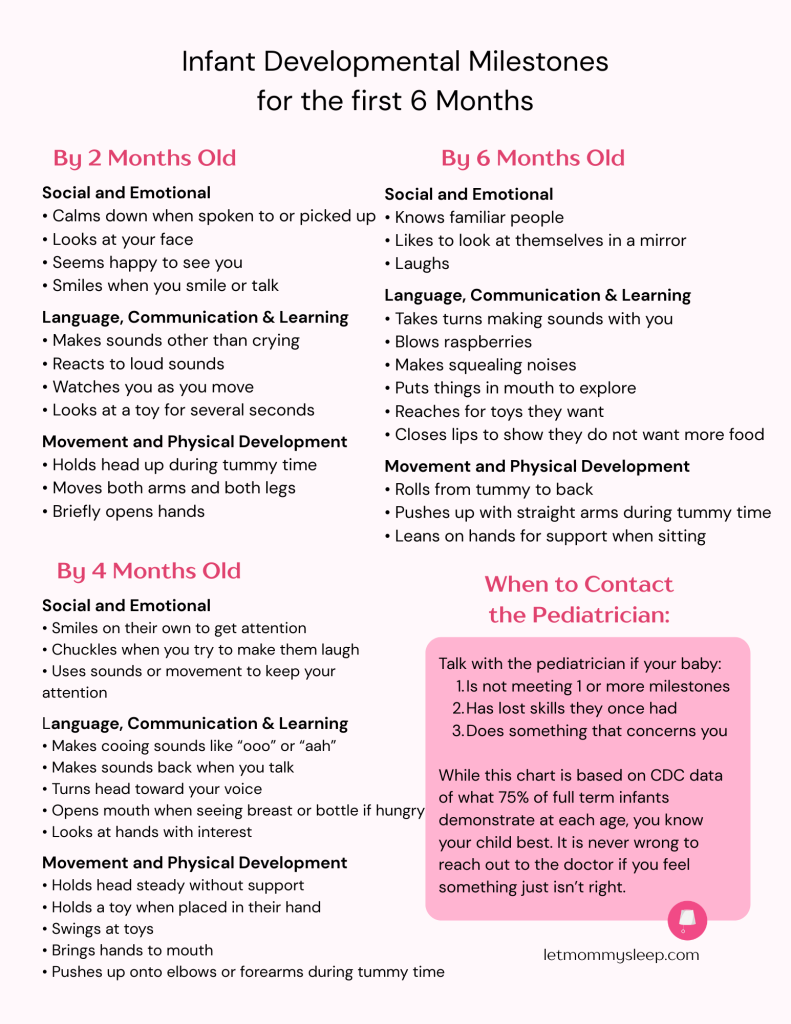
Important Milestones for Infants Age 2 months, 4 Months and 6 Months
The developmental milestones below describe behaviors that 75% or more children demonstrate by a certain age. Remember, this is just a guide to begin conversations with your pediatrician if you’re concerned and doesn’t include every single behavior. These milestones are also typical of full-term babies, so adjusted age should be used when tracking milestones for twins, multiples and premature babies. You can get a detailed description of milestones for the first year and beyond on the CDC website, but below is the list of expected milestones.
Your Baby by 2 Months
Social and emotional milestones include calming when spoken to or picked up, looking at a caregiver’s face, seeming happy to see familiar people, and smiling when smiled at or spoken to.
Language and communication milestones include making sounds other than crying and reacting to loud sounds.
Cognitive milestones include watching people as they move and looking at a toy for several seconds.
Movement and physical development milestones include holding the head up during tummy time, moving both arms and legs, and briefly opening hands.
Your Baby by 4 Months
Social and emotional milestones include smiling independently to get attention, chuckling when someone tries to make them laugh, and using movement or sound to engage others.
Language and communication milestones include making cooing sounds, responding when spoken to, and turning the head toward voices.
Cognitive milestones include opening the mouth when seeing breast or bottle and looking at hands with interest.
Movement and physical development milestones include holding the head steady without support, grasping toys placed in the hand, swinging at toys, bringing hands to the mouth, and pushing up onto elbows or forearms during tummy time.
Your Baby by 6 Months
Social and emotional milestones include: recognizing familiar people, enjoying looking at themselves in a mirror, and laughing.
Language and communication milestones include taking turns making sounds, blowing raspberries, and making squealing noises.
Cognitive milestones include exploring objects by putting them in the mouth, reaching for desired toys, and closing lips to show they do not want more food.
Movement and physical development milestones include rolling from tummy to back, pushing up with straight arms during tummy time, and leaning on hands for support when sitting.
How Parents Can Track Baby Milestones
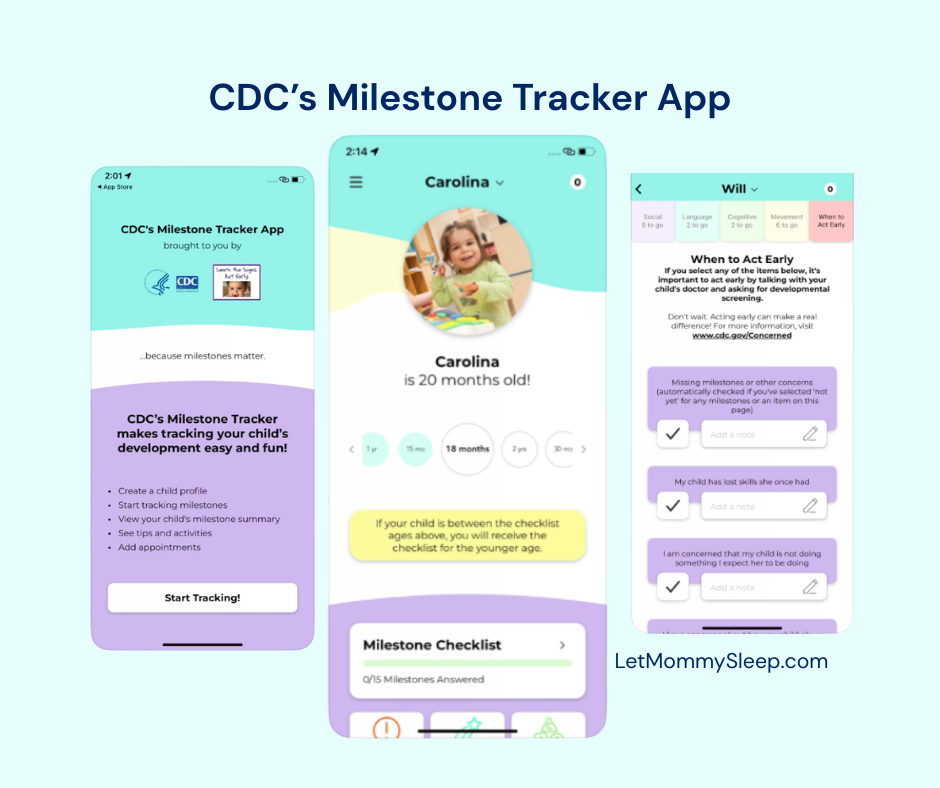
The free App, Milestone Tracker is also available so you can track your baby’s development over time and all in one place. In our night nurses’ opinion, this tool is especially helpful to parents of twins or who have babies children born close in age. Remember also that twins and preemie milestones should be age- adjusted; a baby born 2 months premature will likely reach their milestones later than a full term baby (and that is perfectly fine).
Development is also an ongoing conversation with the pediatrician and as always, parental instinct is an important part of the conversation. You know your child best and it’s never wrong to raise concerns as soon as they arise rather than waiting for a scheduled visit. In addition to looking at the milestone information, your doctor will also ask more open ended questions to gain a better understanding of your child. For example, they might ask if there is anything your baby does (or does not do) that concerns the family or if your child was working on a skills and then lost it.
Development as a Continuing Discussion Between Families and Primary Care Providers
The new guidance is clear to say that parents know their children best and should not wait to contact a doctor with concerns. Further, that early childhood development should be an ongoing conversation between parents and doctors. To facilitate this conversation, the new guidelines contain a specific checklist for each well-child visit (2 months, 4 months, 6 months etc.) rather than checklists by age range.
Doctors and clinicians will also ask open-ended questions such as Is there anything your child does that concerns you? This will also encourage child development as a discussion.
About CDC’s Developmental Milestone Checklists
The milestones in this post are not developmental guidelines or standards and should not be used as screening or diagnostic tools. If developmental concerns are identified, the next steps are formal screening, evaluation or referral using validated tools.
The placement of milestones was informed by a published, peer-reviewed literature review and expert clinical judgment, with milestones placed at ages when approximately 75% or more of children would be expected to demonstrate the behavior. This evidence-based approach is intended to make missed milestones more actionable and reduce delays in identification and referral. The checklists do not include all possible developmental milestones. Inclusion or exclusion of a milestone does not reflect its importance to a child’s overall development.
The milestones and accompanying questions underwent cognitive testing in English and Spanish with parents from diverse racial, ethnic, income, and educational backgrounds. The final language reflects approximately a fifth- to seventh-grade reading level.
Categories
- Corporate Care & Partners
- COVID19 Archive
- En Espanol
- Expert Guides
- Hiring a Night Nanny
- Infant Safety
- Infant Sleep Hub
- Newborn Care
- Postpartum Health
- Twins & Multiples
- Work as a Night Doula
- zPost Archives